Market Intelligence Brief: S&P Above 7,000, Nasdaq Clearing 26,000, and Diplomacy Moves on Multiple Fronts
April 16, 2026 - The S&P 500 is trading above 7,000. The Nasdaq has cleared 26,000 and is pushing to fresh recovery highs. Netanyahu and Lebanon’s President Aoun are expected to speak today for the first time in 34 years. A second round of US-Iran talks may begin in Pakistan within days.
The recovery from the conflict-period lows has extended to levels that carry genuine psychological and technical significance. The S&P 500 above 7,000 is a round number with the weight that round numbers carry in markets: it represents the full reversal of the conflict’s deepest losses and the reclamation of territory that was trading at pre-conflict highs. The Nasdaq clearing 26,000 is the comparable milestone for the technology-weighted index, pushing to fresh recovery highs and extending the advance from the lows set in March with momentum that has sustained through multiple sessions of diplomatic uncertainty.
The diplomatic picture has expanded in a direction few market participants would have predicted at the start of this week. Netanyahu and Lebanese President Joseph Aoun are expected to speak today, a contact that would be the first between an Israeli Prime Minister and a Lebanese head of state in approximately 34 years. The US-Iran ceasefire deadline of April 21st approaches with a second round of talks potentially hosted in Pakistan within days. The naval blockade of Iranian ports remains fully in effect, with ten vessels turned around since Monday and no breaches reported, but the blockade is operating alongside rather than instead of an active diplomatic track.
Netanyahu and Aoun: The Significance of 34 Years
The expected contact between Netanyahu and Lebanese President Aoun is analytically significant well beyond its immediate diplomatic content. Lebanon has been a second front in the conflict since Israel expanded operations against Hezbollah in early March. A direct communication channel between the Israeli Prime Minister and the Lebanese head of state, the first in 34 years, represents an opening of a bilateral track that has been absent from the conflict’s diplomatic landscape entirely.
The significance of 34 years should not be underestimated. The absence of direct Israeli-Lebanese high-level contact for that duration reflects the depth of the political and military estrangement between the two countries. Any conversation, regardless of its immediate outcome, reestablishes a channel that the past three decades have not provided. For the Lebanon front of the conflict specifically, direct Israeli-Lebanese dialogue is a prerequisite for any arrangement that addresses Hezbollah’s operational capacity and Lebanon’s sovereignty simultaneously.
For markets, the Netanyahu-Aoun contact is a secondary diplomatic signal relative to the US-Iran track, but it is relevant because the Lebanon front has been one of the conflict’s most consistently escalating elements. A reduction in the intensity of Israeli operations in Lebanon, made possible by direct dialogue between the parties, would narrow the conflict’s geographic scope and reduce one of the residual risk premiums that even the most optimistic diplomatic scenarios have not fully addressed.
Pakistan Talks: The Second Round and the April 21st Deadline
The potential second round of US-Iran talks hosted in Pakistan, expected within days, arrives five days before the ceasefire’s April 21st deadline. The proximity to the deadline concentrates the diplomatic stakes: a second round that produces visible progress toward a framework for permanent settlement would provide the basis for a ceasefire extension that the market has been pricing as a probability since Tuesday. A second round that replicates the Islamabad breakdown would remove the diplomatic track as a support for the current equity recovery.
The specific detail that ten vessels have been turned around by the naval blockade since Monday with no breaches is an operational indicator worth tracking. A blockade that is being enforced effectively without provoking direct Iranian counter-measures is operating at maximum pressure with minimum immediate escalation. That dynamic cannot persist indefinitely; at some point either the blockade produces the negotiating concessions it is designed to generate, or Iran finds a mechanism to challenge it directly. The absence of breaches in the first several days is not a guarantee of continued restraint.
The April 21st date is now five days away. The market’s current positioning, with the S&P above 7,000 and the Nasdaq above 26,000, embeds a meaningful probability of either a ceasefire extension or sufficient diplomatic progress to justify continued optimism. The gap risk that has been noted throughout the conflict period is present in both directions ahead of a weekend that falls immediately before the deadline date.
The S&P 500 at 7,000: What the Level Actually Means
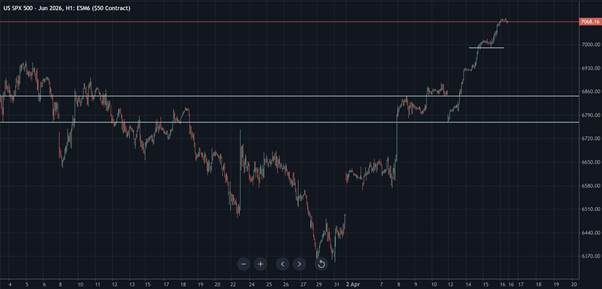
The S&P 500 trading above 7,000 is significant both as a technical milestone and as a fundamental one. Technically, it represents recovery highs that extend well above the support levels that were being tested during the blockade announcement on Monday. The index has recovered from the 6,767 retest of Monday through 6,900 on Tuesday and now to 7,000-plus, a move of approximately 230 points in three sessions on the back of the ceasefire extension reports and the multi-front diplomatic signals of today.
Fundamentally, 7,000 implies a market that is pricing not just ceasefire extension but a meaningful probability of permanent settlement on terms that allow the AI infrastructure investment story, the corporate earnings cycle, and the economic trajectory to resume without the geopolitical risk premium that suppressed valuations through March and early April. A market at 7,000 is a market that believes the worst of the conflict period is behind it, whilst acknowledging that the diplomatic process has not yet concluded.
The Nasdaq clearing 26,000 and pushing to fresh recovery highs is the parallel milestone. The index that suffered the most from the conflict’s rate sensitivity, as elevated oil drove inflation expectations and central bank tightening signals, is recovering the most sharply as those pressures reduce. The AI infrastructure story, represented most recently by the Broadcom-Google seven-year deal, has not deteriorated during the conflict period. The gap between the valuations that story justified in February and the valuations the conflict suppressed is now being closed with the speed that the market’s accumulated positioning allows.
UK GDP, the IMF Forecast, and the Data Paradox
UK GDP for February printed at plus 0.5% month-on-month, well ahead of the plus 0.1% consensus. The beat is constructive as a data point but carries the same paradox that has characterised much of the economic data through the conflict period: February was before the conflict began, making the strong reading a measure of pre-conflict economic momentum rather than current conditions.
The IMF’s subsequent cut to the UK growth forecast for 2026 to 0.8% provides the conflict-period reality check. The IMF is projecting that the conflict’s economic impact, elevated energy costs, trade disruption, suppressed investment, and the policy tightening that the inflationary pressure is requiring, will reduce UK growth for the full year to a level that the pre-conflict February data would not have implied. The divergence between the February GDP beat and the 0.8% full-year IMF forecast captures the conflict’s economic cost in a single juxtaposition: the economy was strong going in, the IMF expects the conflict to take a meaningful portion of that strength away across the year.
For investors assessing the UK’s economic trajectory, the question is whether the diplomatic progress visible in today’s session reduces the IMF forecast’s downside assumptions or whether the conflict’s structural economic damage has already been done in ways that do not reverse quickly. Energy cost transmission, investment deferrals, and consumer confidence suppression all take time to unwind even after the geopolitical situation improves.
Netflix and PepsiCo: Earnings Across the Consumer Spectrum
PepsiCo reports before the US open with consensus of EPS $1.55 on $18.93 billion in revenue, implying approximately 5% growth on both lines. As a consumer staples bellwether, PepsiCo’s results will be watched for margin pressure from tariff-related input cost increases and for any read-through on consumer demand patterns in an environment where energy costs have been elevated for six weeks. Tariff impacts on packaging, transport, and ingredient costs have been a consistent background concern for consumer staples companies through the conflict period.
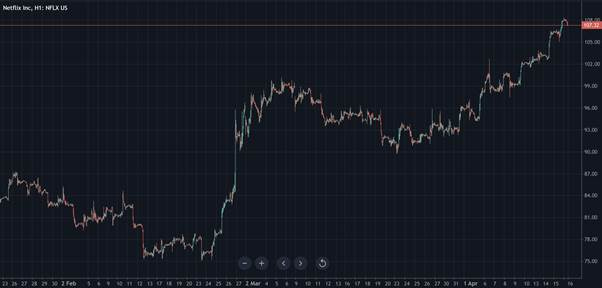
Netflix reports after the close with consensus of EPS $0.76 on $12.17 billion in revenue, implying approximately 15% revenue growth year-on-year. Subscriber trends and any commentary on advertising tier uptake will be the primary focus. Netflix is a useful barometer of discretionary consumer spending on entertainment in a period when household budgets have been compressed by elevated energy costs. Whether consumers have maintained or reduced streaming subscriptions through the conflict period provides a specific and measurable indicator of consumer resilience at the discretionary margin.
The Bottom Line
Thursday opens with the recovery extending to fresh highs that carry genuine significance: S&P 500 above 7,000, Nasdaq above 26,000, Netanyahu and Aoun expected to speak for the first time in 34 years, and a second round of US-Iran talks potentially beginning in Pakistan ahead of the April 21st deadline. The blockade is enforced and functioning without breach. The diplomatic track is active on multiple fronts simultaneously.
The UK’s GDP beat and the IMF’s growth downgrade sit alongside each other as the data picture’s honest summary of the conflict’s economic impact: strong entering, meaningfully weaker by year-end. PepsiCo and Netflix report today across the consumer spectrum.
The April 21st deadline is five days away. The market at 7,000 is pricing optimism. The optimism has more diplomatic underpinning than at any previous point in the conflict period. The test of whether it is justified arrives within the week.
Lunaro is an execution-only service provider. This material is a marketing communication and is provided for general information and educational purposes only. It does not take into account your personal circumstances, objectives or needs. Any opinions are those of the author at the time of writing and may change without notice. Nothing in this material constitutes (or should be construed as) financial, investment, legal, regulatory or tax advice, or a recommendation to engage in any investment activity. You should not rely on this material when making investment or trading decisions.
This material has not been prepared in accordance with legal requirements designed to promote the independence of investment research and is not subject to any prohibition on dealing ahead of the dissemination of investment research. Lunaro may deal as principal and/or have an interest in the financial instruments or markets referred to in this material in the ordinary course of its business, including at or around the time of publication, and does not seek to take advantage of this material prior to its dissemination.
While reasonable care has been taken in preparing this material, no representation or warranty is made as to its accuracy or completeness and Lunaro accepts no liability for any loss arising from any use of, or reliance on, this material. Past performance is not indicative of future results.
CFDs are complex instruments and come with a high risk of losing money rapidly due to leverage. Approximately 80% of retail investor accounts lose money when trading CFDs with this provider. You should consider whether you understand how CFDs work and whether you can afford to take the high risk of losing your money.
Lunaro Financial Services Limited is authorised and regulated by the Financial Conduct Authority (FCA), Register No. 184333. Registered in England and Wales, No. 03148972.
Lunaro Markets Limited is authorised and regulated by the Financial Services Regulatory Authority (FSRA) of Abu Dhabi Global Market (ADGM), Financial Services Permission No. 200034, Registration No. 000005466.


Comments
Post a Comment