Market Intelligence Brief: The Ceasefire That Markets Have Been Waiting Six Weeks For
April 8, 2026 - A conditional two-week ceasefire between the US and Iran, agreed just before Tuesday’s deadline, has produced the most significant positive market session of the conflict period. The Strait of Hormuz is reopening. The S&P 500 has broken through resistance. The DAX is up 4.47%.
The hard evidence arrived. Just before Tuesday evening’s deadline, a conditional two-week ceasefire was agreed between the US and Iran. The Strait of Hormuz will fully reopen to commercial shipping traffic. Global equity futures surged on the announcement, with the S&P 500 gaining nearly 200 points overnight. Wednesday opens with the most decisive and broad-based positive market session since the conflict began on February 27th.
The ceasefire is conditional and limited to two weeks, providing time for negotiations toward a permanent settlement. It is not a resolution. The underlying conflict’s causes have not been addressed, the diplomatic gap between a US 15-point plan and an Iranian 5-point counter has not been bridged, and the two-week window will itself generate its own market sensitivity as it progresses. But the immediate economic consequences of the conflict, elevated oil prices, restricted shipping, central bank tightening bias, and suppressed corporate and consumer confidence, have all received a credible near-term reprieve. The market is pricing that reprieve with appropriate conviction.
The Ceasefire’s Economic Significance
The two-week ceasefire accomplishes three economically immediate things simultaneously. First, it removes the acute risk premium from oil by providing a defined period in which the Strait of Hormuz returns to normal commercial operation. Oil prices will fall as the market prices out the supply disruption risk that has kept crude near $100 for six weeks. The speed and scale of that fall will depend on how credible the ceasefire’s implementation is assessed to be in the first hours and days of its operation.
Second, the reopening of the Strait restores the LNG supply chains that were disrupted by the closure, directly reducing the energy security risk that had been driving the DAX’s persistent underperformance and the ECB’s tightening bias. The European inflation expectations reading of 43.4 against a 24.5 forecast, which was the most alarming single data point of the conflict period, will not immediately reverse, but the supply-side driver of those expectations is being addressed. Real inflation and inflation expectations will take weeks and months to moderate; the removal of the supply pressure is the necessary first step.
Third, and most structurally significant for equity markets, the ceasefire provides a two-week window of reduced uncertainty in which corporate investment decisions, consumer confidence, and central bank policy assessments can begin to normalise. The suppression of confidence that an active and unresolved geopolitical conflict generates does not disappear on the first day of a ceasefire, but it begins to lift as the time horizon of resolution extends from unknown to defined.
The S&P 500 Breaks Through Resistance
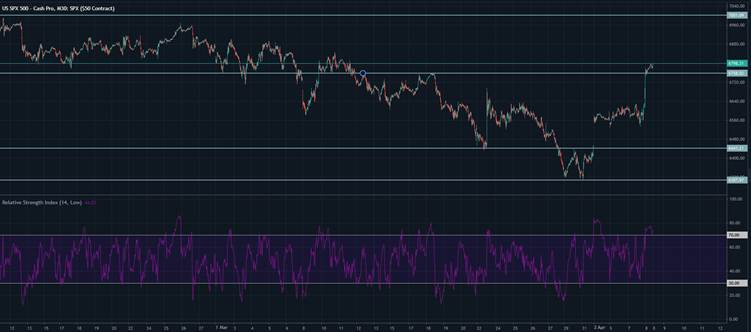
The S&P 500 has broken through the resistance level that has defined the ceiling of the conflict period’s recovery attempts. The commentary’s observation that fundamental news outweighs technical levels in this move is the correct framing: technical resistance concentrates selling interest from participants using the level as a reference point, but when the fundamental input is sufficiently large and credible, it overwhelms that selling interest and the break occurs with force.
A ceasefire announcement, combined with Strait reopening, is precisely the category of fundamental news that overrides technical structure. The break through resistance is not a technical event; it is the market removing the geopolitical risk premium that had been defining the upper boundary of acceptable pricing for six weeks. With that premium being repriced lower, the technical level becomes irrelevant because the sellers concentrated there were holding positions premised on the conflict’s continuation.
The Nasdaq 100 is up 3.49%, the stronger performer of the two US indices, reaching 25,046. The next major resistance level is approximately 500 points above the current price. The Nasdaq’s outperformance continues the pattern observed throughout the conflict period: rate-sensitive growth technology stocks are most directly affected by the inflationary and tightening pressures the conflict introduced, and benefit most sharply when those pressures are addressed. A ceasefire that removes the primary driver of the ECB and other central banks’ tightening bias disproportionately relieves the discount rate pressure on growth valuations.
The DAX Leads Europe: 4.47% and the Structural Logic
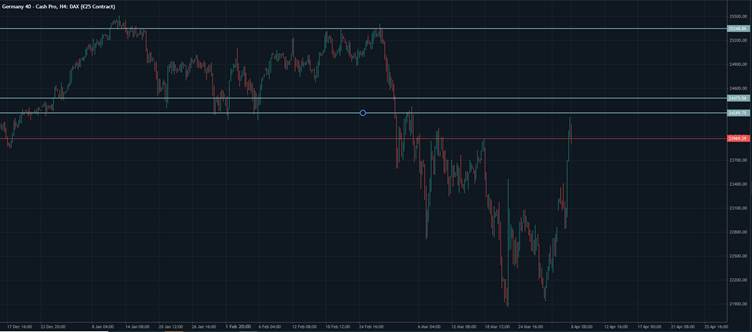
Germany 40 is up 4.47%, the strongest single-session gain of the entire conflict period for any major index tracked in this commentary. The structural logic is the precise inverse of every session in which the DAX absorbed the sharpest losses: Germany’s specific vulnerabilities, industrial energy intensity, LNG supply chain exposure, ECB tightening pressure, and trade dependence, are each most directly addressed by the ceasefire and Strait reopening.
LNG supply chains that were disrupted by the Strait closure can now resume. The energy cost pressure on German manufacturing that was driving the ECB’s tightening concern is reduced. The inflation expectations that had surged to nearly double their forecast level have lost their primary supply-side driver. The entire stack of headwinds that made the DAX the worst-performing major European index throughout the conflict period is being partially removed simultaneously.
The DAX is testing resistance around 24,600. That level is approximately 640 points above where it was trading at Monday’s close, and its approach confirms that the index has recovered a substantial portion of the ground lost during the conflict period’s most acute phases. Whether the resistance at 24,600 yields depends on how the two-week ceasefire period progresses and whether the negotiations toward a permanent settlement show sufficient early momentum to sustain the recovery’s pace.
The FTSE UK 100 is up 2.52%, reaching 10,612 and extending well above the resistance levels that defined the ceiling of its conflict-period range. The FTSE’s smaller gain relative to the DAX reflects the same asymmetric logic: the index that fell less during the conflict recovers less dramatically when it ends, because it priced less of the risk in the first place.
Foreign Exchange: Safe-Haven Premium Begins Unwinding
EURUSD is up 0.75% at 1.16825, GBPUSD is higher by 1.01% at 1.34302, and USDJPY is lower by 0.78% at 158.39. The direction and pattern are exactly what the analysis of the conflict period’s safe-haven positioning anticipated: as the geopolitical risk that generated sustained dollar demand is addressed, the accumulated safe-haven premium begins to unwind.
The EURUSD move above 1.16 represents a meaningful recovery from the levels seen during the conflict’s most acute phases, when the pair was trading around 1.14 and the resistance at 1.1600 had been identified repeatedly as the threshold requiring more certainty than signals could provide. The ceasefire has provided that certainty, and the pair has moved through the resistance with the same force that equities have broken through theirs.
The pace of the safe-haven unwind will be one of the more watched currency market developments of the coming sessions. Four weeks of accumulated safe-haven dollar positioning is not reversed in a single session. As the ceasefire’s implementation is confirmed and the Strait’s reopening becomes operational rather than announced, further dollar softening should be expected. The two-week window of the ceasefire provides a defined time horizon within which that unwinding can proceed, but the permanence of the move depends on whether the negotiations that follow produce a durable settlement.
Oil, the 10-Year Note, and the EIA Stocks Data
Oil prices will be the most closely watched commodity market of the session. The Strait of Hormuz reopening removes the physical supply disruption that has been maintaining the elevated price for six weeks. The EIA crude oil stocks data, due at 15:30, will provide the first inventory reading in the context of the ceasefire and will begin to quantify the supply picture as the Strait returns to commercial operation.
The 10-Year Note Auction at 18:00 carries specific relevance in the context of the ceasefire. If the market reads the ceasefire as a credible path toward reduced inflationary pressure, the demand for 10-year Treasuries at this afternoon’s auction may reflect a repricing of the rate expectations that the conflict had been driving toward tighter territory. A strong auction with lower yields than the prior reading of 4.22% would confirm that the bond market is incorporating the same de-escalation signal as equities and currencies.
The RBNZ kept rates at 2.25%, consistent with the maintained holds seen across major central banks through the conflict period. As the conflict’s inflationary impulse is addressed, the collective tightening bias that the ECB, Bank of England, and Bank of Japan signalled during March will be reassessed in the light of a world in which the primary supply-side inflation driver is being removed.
Two Weeks and What Follows
The ceasefire’s conditional and two-week character is the most important qualifier on the session’s extraordinary positive moves. The market is not pricing a permanent settlement; it is pricing the removal of the acute risk premium and the opening of a defined negotiating window. Whether the window produces the substantive diplomatic progress that the incompatible 15-point and 5-point plans suggested was distant will determine whether the two-week recovery extends or whether a return to the conflict generates a reversal of the kind that has characterised the conflict period throughout.
The negotiating dynamics have not fundamentally changed. The US and Iran still hold maximalist positions. What has changed is that both parties have demonstrated willingness to step back from escalation at a deadline, providing evidence that neither side is committed to unlimited escalation and that the space for a negotiated conclusion exists.
The direction has changed. The uncertainty has not disappeared.
The Bottom Line
April 8th opens as the most significant positive session of the conflict period. A conditional two-week ceasefire, the Strait of Hormuz reopening, the S&P 500 breaking through resistance, the DAX up 4.47%, the Nasdaq at 25,046, and GBPUSD gaining over 1% overnight. Six weeks of geopolitical risk premium is beginning to deflate.
The ceasefire is not a resolution. It is the most credible signal the conflict has produced, delivering on the hard evidence the market has been requesting, and providing a two-week window in which the diplomatic process can produce something more durable. The EIA crude stocks data and the 10-Year Note Auction will provide the afternoon’s most relevant economic inputs. No major earnings today.
The resistance levels that the market was hovering at yesterday have been broken with force. What was the ceiling is now the floor. Whether it holds as such depends on the next two weeks.
Lunaro is an execution-only service provider. This material is a marketing communication and is provided for general information and educational purposes only. It does not take into account your personal circumstances, objectives or needs. Any opinions are those of the author at the time of writing and may change without notice. Nothing in this material constitutes (or should be construed as) financial, investment, legal, regulatory or tax advice, or a recommendation to engage in any investment activity. You should not rely on this material when making investment or trading decisions.
This material has not been prepared in accordance with legal requirements designed to promote the independence of investment research and is not subject to any prohibition on dealing ahead of the dissemination of investment research. Lunaro may deal as principal and/or have an interest in the financial instruments or markets referred to in this material in the ordinary course of its business, including at or around the time of publication, and does not seek to take advantage of this material prior to its dissemination.
While reasonable care has been taken in preparing this material, no representation or warranty is made as to its accuracy or completeness and Lunaro accepts no liability for any loss arising from any use of, or reliance on, this material. Past performance is not indicative of future results.
CFDs are complex instruments and come with a high risk of losing money rapidly due to leverage. Approximately 80% of retail investor accounts lose money when trading CFDs with this provider. You should consider whether you understand how CFDs work and whether you can afford to take the high risk of losing your money.
Lunaro Financial Services Limited is authorised and regulated by the Financial Conduct Authority (FCA), Register No. 184333. Registered in England and Wales, No. 03148972.
Lunaro Markets Limited is authorised and regulated by the Financial Services Regulatory Authority (FSRA) of Abu Dhabi Global Market (ADGM), Financial Services Permission No. 200034, Registration No. 000005466.


Comments
Post a Comment