Market Intelligence Brief: Recovery, Ceasefire Extension Talks, and the Banks Begin Reporting
April 14, 2026 - Markets are broadly recovering from Monday’s blockade-driven losses. Reports that the US and Iran are weighing fresh negotiations to extend the ceasefire before it expires next week have stabilised sentiment. The S&P 500 is back above 6,900. JPMorgan and Johnson and Johnson report today.
Tuesday opens with a recovery session that the previous day’s severity made necessary to assess carefully. Markets are broadly higher, the S&P 500 has reclaimed 6,900, the Nasdaq is trading above 25,600, and the dollar is softer across the board. The catalyst is specific: reports that the US and Iran are considering fresh negotiations to extend the ceasefire before it expires on April 22nd. The blockade remains active. The conflict has not resolved. But the possibility of ceasefire extension before expiry has provided sufficient positive input for markets to partially retrace Monday’s blockade-driven losses.
Trump’s commentary adds the familiar note of ambiguity that has characterised every diplomatic signal of the conflict period. The ceasefire is “holding well,” he stated, but he does not care whether Iran returns to the table. The market’s recovery in the face of that indifference suggests investors are pricing the extension reports rather than the presidential commentary, assigning probability to a negotiated extension without requiring an endorsement from the party whose position would determine the outcome. The pattern of the conflict period continues: markets price the most constructive available interpretation of partial signals.
The Ceasefire Extension: What Reports of Negotiations Actually Imply
Reports that fresh negotiations are being weighed to extend the ceasefire before its April 22nd expiry carry analytical weight that the “great progress” social media posts of earlier in the conflict did not. An extension negotiation is a defined and specific diplomatic action: it requires both parties to agree on new terms for continuing the pause, implicitly acknowledging that the two-week window has not produced a permanent settlement but that both sides prefer a continued pause to a return to active hostilities.
The analytical significance is in what it implies about each party’s position. If the US and Iran are both reportedly weighing an extension, neither has concluded that its interests are better served by letting the ceasefire expire and resuming the conflict in its current form. The naval blockade, which Iran characterised as piracy, has not pushed Tehran to abandon the diplomatic track entirely. The talks breakdown in Islamabad, which prompted the blockade, has not persuaded Washington that pure military pressure is the correct path. Extension discussions, even reported rather than confirmed, suggest that both parties retain an interest in preserving the diplomatic option.
For markets, a ceasefire extension would provide additional time within which the permanent settlement that the Islamabad talks failed to produce could be pursued through a different format or framework. It would also defer the April 22nd cliff edge that has been looming over every positive diplomatic signal of the past week. A market that has been conditioned to price binary outcomes at specific deadlines would treat an extension as the removal of the nearest binary event, reducing the gap risk that has suppressed position-taking through multiple sessions.
The S&P 500 Back Above 6,900 and the Nasdaq at 25,600
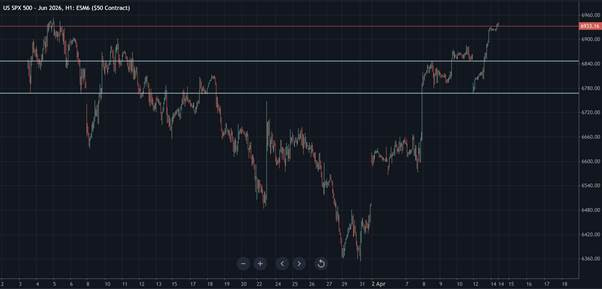
The S&P 500 trading above 6,900 represents a meaningful recovery from Monday’s retest of 6,767 and places the index in territory last occupied during the post-ceasefire surge of the previous week. The speed of the recovery from the blockade-driven losses is consistent with the market’s established pattern of sharp moves in both directions on significant geopolitical catalysts, followed by partial retracement as the initial pricing is refined.
The practical implication of 6,900 is technical and fundamental simultaneously. Technically, it confirms that the support structure established by Tuesday’s ceasefire rally has not been permanently broken by Monday’s blockade announcement. The 6,767 level held, was retested, and the market has recovered above it. Fundamentally, 6,900 reflects a market that is pricing a probability distribution across the ceasefire extension, failed extension, and permanent deal scenarios rather than pricing any single outcome with certainty.
The Nasdaq trading above 25,600 is similarly instructive. The index moved from 24,900 on Monday’s blockade announcement back above 25,600 on Tuesday’s extension reports, a recovery of approximately 700 points in a single session. The resistance at 25,181 that had been the ceiling for much of the post-ceasefire consolidation has now been broken to the upside in the recovery, which changes its technical status from resistance to a potential support level if the Nasdaq retests it on any subsequent pullback.
JPMorgan: The Financial Sector’s First Word on the Conflict Period
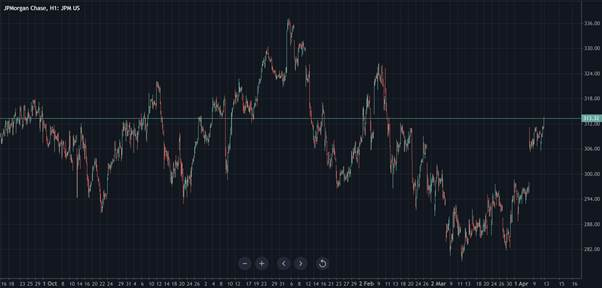
JPMorgan Chase reports with consensus expectations of EPS of $5.49 on $48.77 billion in revenue. As the largest US bank and the financial sector’s most closely watched bellwether, JPMorgan’s results provide the first major institutional assessment of what six weeks of geopolitical conflict, elevated oil prices, suppressed corporate confidence, and central bank tightening signals have done to the financial system’s operational performance.
The numbers themselves will be assessed in the context of a first quarter that spanned the pre-conflict period of January and February and the conflict’s opening weeks in March. Investment banking activity, which had been recovering from a subdued 2024, will show whether the conflict disrupted the deal pipeline that had been rebuilding. Trading revenues, particularly in commodities and fixed income, may have benefited from the extraordinary volatility the conflict generated. Credit conditions, including loan quality and provisioning, will provide the first institutional assessment of whether the conflict’s economic pressures have reached corporate and consumer balance sheets.
Management commentary is the most market-relevant component. JPMorgan’s characterisation of how the geopolitical backdrop is affecting client activity, capital markets appetite, and the economic outlook will carry weight that no economic survey can match. A major investment bank’s forward view on deal flow, credit conditions, and client confidence provides the financial system’s own assessment of where the conflict has left the economy.
Johnson and Johnson: Defensive Healthcare in an Uncertain Environment
Johnson and Johnson reports with consensus expectations of EPS of $2.67 on $23.54 billion in revenue. As a diversified healthcare company with pharmaceutical, MedTech, and consumer health segments, J&J provides a defensive read on spending patterns in an environment where consumer and corporate confidence has been suppressed. Healthcare demand is relatively insensitive to geopolitical disruption compared to industrial or consumer discretionary sectors, making J&J’s results a useful baseline for assessing whether the conflict’s economic impact has reached even the more defensively positioned areas of the corporate landscape.
Pharmaceutical growth and any guidance updates will be the specific watch items. If J&J is able to deliver results consistent with pre-conflict expectations and provide forward guidance without material revision, it would suggest that the conflict’s economic damage has remained concentrated in the energy, industrial, and confidence-sensitive sectors rather than spreading uniformly across the corporate economy.
Foreign Exchange: Dollar Softening Reflects the Extension Signal
EURUSD is up 0.28%, GBPUSD is higher by 0.32%, and USDJPY is lower by 0.31%. The dollar softening across all major pairs is the currency market’s pricing of the same ceasefire extension signal that has driven the equity recovery. A market that assigns meaningful probability to a ceasefire extension reduces its safe-haven dollar positioning in the same way it reduces its equity risk hedging.
The moves are contained rather than dramatic, consistent with a market that is pricing a report of extension talks rather than a confirmed extension. The currency market, which has consistently applied a higher evidentiary standard to diplomatic signals than equity markets throughout the conflict period, is again moving less than equities on the same input. EURUSD above 1.17 is constructive but does not yet represent the kind of break that a confirmed permanent settlement would generate.
The FTSE’s 0.32% decline while continental European indices recover is the only equity market outlier of the session. The FTSE’s underperformance relative to its European peers on a risk-on day is likely related to the UK’s diplomatic positioning from Monday, where Prime Minister Starmer’s distancing from the US naval blockade placed the UK in a distinct posture. Whether that posture carries sustained market implications for sterling and UK equities, or resolves as a temporary diplomatic nuance, will become clearer as the ceasefire extension discussions develop.
The Bottom Line
Tuesday provides the partial recovery that Monday’s blockade-driven losses required the market to assess. The S&P 500 is back above 6,900. The Nasdaq is above 25,600. The dollar is softer. The ceasefire extension reports have done the work of providing a positive catalyst in a session where no new escalation has arrived to offset it.
JPMorgan and Johnson and Johnson provide the session’s primary earnings context. JPMorgan’s commentary on client behaviour and capital markets conditions will be the financial sector’s first direct account of how the conflict period has affected institutional activity. J&J’s defensive positioning makes it a useful baseline for assessing how broadly the conflict’s economic disruption has spread.
The ceasefire expires April 22nd. Extension talks are reportedly being weighed. The market is pricing a probability rather than a certainty. That is the most honest description of where things stand on Tuesday morning of a week that began with a naval blockade and is now, provisionally, finding its footing again.
Lunaro is an execution-only service provider. This material is a marketing communication and is provided for general information and educational purposes only. It does not take into account your personal circumstances, objectives or needs. Any opinions are those of the author at the time of writing and may change without notice. Nothing in this material constitutes (or should be construed as) financial, investment, legal, regulatory or tax advice, or a recommendation to engage in any investment activity. You should not rely on this material when making investment or trading decisions.
This material has not been prepared in accordance with legal requirements designed to promote the independence of investment research and is not subject to any prohibition on dealing ahead of the dissemination of investment research. Lunaro may deal as principal and/or have an interest in the financial instruments or markets referred to in this material in the ordinary course of its business, including at or around the time of publication, and does not seek to take advantage of this material prior to its dissemination.
While reasonable care has been taken in preparing this material, no representation or warranty is made as to its accuracy or completeness and Lunaro accepts no liability for any loss arising from any use of, or reliance on, this material. Past performance is not indicative of future results.
CFDs are complex instruments and come with a high risk of losing money rapidly due to leverage. Approximately 80% of retail investor accounts lose money when trading CFDs with this provider. You should consider whether you understand how CFDs work and whether you can afford to take the high risk of losing your money.
Lunaro Financial Services Limited is authorised and regulated by the Financial Conduct Authority (FCA), Register No. 184333. Registered in England and Wales, No. 03148972.
Lunaro Markets Limited is authorised and regulated by the Financial Services Regulatory Authority (FSRA) of Abu Dhabi Global Market (ADGM), Financial Services Permission No. 200034, Registration No. 000005466.


Comments
Post a Comment