Market Intelligence Brief: Israel-Lebanon Ceasefire, “Very Close” to an Iran Deal, and a Nasdaq Winning Streak Not Seen Since 2009
April 17, 2026 - A 10-day Israel-Lebanon ceasefire came into force overnight. Trump says the US and Iran are “very close” to a deal. The Nasdaq has closed higher for 12 consecutive sessions, its longest winning streak since 2009. The week that began with a naval blockade ends with the most constructive diplomatic picture of the entire conflict period.
Market data and geopolitical developments tracked via Investing.com throughout the conflict period have consistently illustrated the direct relationship between diplomatic signals and asset price movements. Friday opens with that relationship at its most positive: a 10-day Israel-Lebanon ceasefire is in effect, President Trump has said the US and Iran are “very close” to a deal, with talks potentially resuming this weekend, and European equities are firmer, with US futures broadly stable. The Nasdaq 100 closed higher for a 12th consecutive session on Thursday, its longest winning streak since 2009, extending the recovery from the conflict-driven lows with a momentum that has now become its own analytical story.
The UK and France are chairing a Strait of Hormuz freedom-of-navigation meeting today, with approximately 40 countries participating. The US naval blockade remains in place. The ceasefire is described as fragile, with both sides trading strikes in the hours before it took effect. The diplomatic architecture being assembled across multiple tracks simultaneously, Israel-Lebanon, US-Iran, and a multilateral Strait meeting, is more complex and more substantive than anything the conflict period has produced. The week’s closing session reflects the market’s assessment of that architecture.
The Israel-Lebanon Ceasefire: A Second Front Addressed
The 10-day Israel-Lebanon ceasefire that came into force overnight addresses the conflict’s second front, which has been operating in parallel with the US-Iran military engagement since early March. The ceasefire is described as fragile, and both sides trading strikes in the hours before it took effect is a reminder that fragile is an accurate description, not a diplomatic understatement. A ceasefire that begins with active violations cannot be assumed to be durable.
The significance, nonetheless, is structural rather than merely temporary. An Israel-Lebanon ceasefire, however fragile, separates the two fronts of the conflict, simplifying the diplomatic picture. A US-Iran deal that resolves the primary front becomes more achievable when the Lebanon dimension is addressed separately through the direct Israeli-Lebanese channel that Netanyahu and Aoun’s communication has opened. The ceasefire may not last ten days without incident, but its existence as a framework is analytically meaningful.
For markets, the Israel-Lebanon ceasefire reduces the geographic scope of the conflict’s active military dimension. Each reduction in scope reduces the premium for geographic spread risk that equity markets had been embedding since Israel expanded its Lebanon operations in March. Friday’s DAX gain of 0.78% and Euro Stoxx 50 gain of 0.58% reflect, in part, the European market’s specific relief at a conflict that has been contracting rather than expanding.
“Very Close”: Trump’s Framing in the Context of the Conflict’s Credibility Pattern
Trump’s statement that the US and Iran are “very close” to a deal, with talks potentially resuming this weekend, is the latest in the sequence of presidential optimism characterisations that the conflict period has trained the market to assess with calibrated scepticism. “Ahead of schedule,” “wants a deal so badly,” “leaving very soon,” and now “very close” form a progression that each produced market movements of diminishing initial amplitude as the pattern of subsequent revision became established.
What makes “very close” analytically different from its predecessors in the sequence is the diplomatic context in which it sits. Previous optimistic framings arrived without substantive diplomatic infrastructure to support them. “Very close” arrives alongside a 10-day Israel-Lebanon ceasefire, a multilateral 40-nation Strait meeting co-chaired by the UK and France, a second round of US-Iran talks expected in Pakistan this weekend, and a Nasdaq that has now completed 12 consecutive higher closes. The market’s assessment of the signal includes its context, and the context is materially stronger than it has been at any previous point in the conflict.
The weekend talks dimension also carries a specific risk that Friday’s cautious trading reflects. Weekend developments have been the source of the conflict’s most significant market-moving events in both directions: the initial strikes, the Strait closure, the ceasefire announcement, and the naval blockade all arrived outside trading hours. A “very close” deal announced on Saturday or Sunday would leave a significant gap open on Sunday evening. A breakdown in this weekend’s talks would test the support that 12 sessions of Nasdaq gains have established.
The Nasdaq’s 12-Session Winning Streak: What It Means
The Nasdaq 100’s 12 consecutive higher closes, its longest winning streak since 2009, is a data point that requires specific contextualisation to be properly assessed. A 12-session winning streak is not merely momentum; it is the market’s accumulated daily verdict that the balance of incoming information has been positive on each of those 12 days. In the context of the conflict period, during which negative sessions dominated from late February through mid-March, the reversal to 12 consecutive positive sessions represents a fundamental shift in the balance of signals the market has been receiving and pricing.
The 2009 comparison is meaningful. The 2009 winning streak occurred during the recovery from the global financial crisis, when markets were rebounding from structurally distressed levels on the back of policy interventions and improving economic data. The current streak is occurring in the recovery from a geopolitically driven decline, on the back of diplomatic progress and the partial removal of a conflict premium that had suppressed valuations. The parallel lies in the character of the recovery rather than the cause. In both cases, a market that had priced extreme scenarios unwinds that pricing as those scenarios become less probable.
The Nasdaq holding above 26,000 and pausing near the recovery highs is the technical expression of a market that has made substantial ground and is consolidating that ground rather than immediately extending further. Consolidation near recent highs after a 12-session advance is constructive rather than concerning; it reflects the market absorbing the gains rather than reversing them, and provides the platform from which a confirmed deal announcement would launch the next leg.
The 40-Nation Strait of Hormuz Meeting: Multilateral Architecture Taking Shape
The UK and France chairing a Strait of Hormuz freedom-of-navigation meeting with approximately 40 countries participating is the most significant development in the multilateral dimension of the conflict period. The Strait, which has been the central economic vulnerability throughout the seven weeks of the conflict, is now the subject of a structured multilateral diplomatic effort to restore and guarantee freedom of navigation.
The meeting’s significance is both immediate and structural. Immediately, it demonstrates that the international community’s interest in Strait access has generated the political will for a formal multilateral response, moving beyond individual national statements toward a collective framework. Structurally, a 40-nation meeting on Strait navigation provides the international legitimacy and oversight mechanism that any permanent settlement of the Strait’s access question would need to reference.
The UK and France co-chairing the meeting is consistent with the UK’s diplomatic positioning from Monday, when Prime Minister Starmer distanced the UK from the naval blockade and focused on Strait stabilisation. France’s co-chairmanship adds the weight of a permanent member of the UN Security Council to the format. Forty nations agreeing to participate in a single meeting on this issue within a week of the naval blockade’s imposition suggests that the international appetite for a multilateral resolution of the Strait question is substantial and rapidly mobilising.
Truist Financial and State Street: The Financials Sector Reading Continues
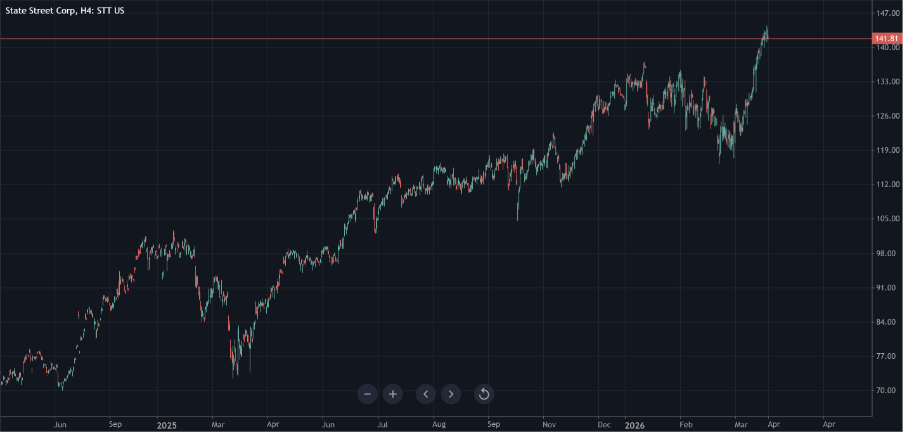
Truist Financial and State Street both report before the US open, with consensus EPS of $1.00 on $5.17 billion in revenue for Truist and $2.61 on $3.65 billion in revenue for State Street.
Source: www.investing.com
Both prints continue the week’s earnings season in the financial sector, following JPMorgan’s results earlier in the week.
State Street’s specific profile as a custody bank and asset manager makes its results a useful read on institutional asset flows and the behaviour of institutional investors through the conflict period. Custody banks observe the actual movement of assets across portfolios in real time, and State Street’s commentary on where institutional investors have been positioning, reducing exposure to risk assets or maintaining allocations through the conflict period’s volatility, provides a perspective that market price data alone cannot capture.
Truist, as a regional bank, will provide a read on credit conditions and consumer and commercial banking activity in its geographic markets, complementing the large-cap bank picture JPMorgan provided earlier in the week.
The Bottom Line
Friday closes a week that has traced the full arc of the conflict period’s most volatile phase in compressed form: Monday’s naval blockade, Tuesday’s recovery on extension talks, Thursday’s 12-session Nasdaq winning streak, and Friday’s Israel-Lebanon ceasefire alongside “very close” to an Iran deal. The week ends with the most constructive diplomatic picture of the entire seven-week conflict.
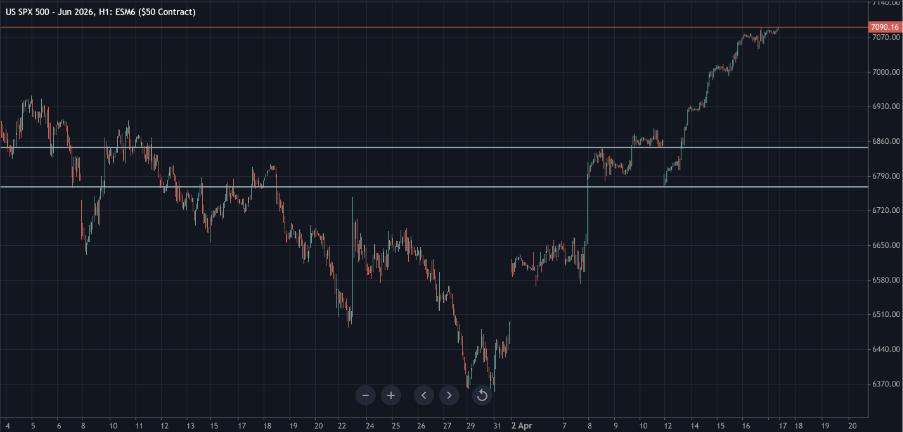
The S&P 500 is consolidating above 7,000. The Nasdaq is holding above 26,000 after 12 consecutive higher sessions. Germany 40 is up 0.78% on the news of the ceasefire. The 40-nation Strait meeting marks the emergence of a multilateral architecture. Weekend talks between the US and Iran are expected.
The weekend ahead carries gap risk in both directions. A deal announced on Saturday or Sunday gaps the market meaningfully higher. A breakdown sends it back toward the levels from which this week’s gains were made. The market, at current levels, is pricing in optimism. The diplomatic infrastructure supporting that optimism is the most substantive of the conflict period. Whether it delivers within the next seventy-two hours is the question the weekend holds.
Lunaro is an execution-only service provider. This material is a marketing communication and is provided for general information and educational purposes only. It does not take into account your personal circumstances, objectives or needs. Any opinions are those of the author at the time of writing and may change without notice. Nothing in this material constitutes (or should be construed as) financial, investment, legal, regulatory or tax advice, or a recommendation to engage in any investment activity. You should not rely on this material when making investment or trading decisions.
This material has not been prepared in accordance with legal requirements designed to promote the independence of investment research and is not subject to any prohibition on dealing ahead of the dissemination of investment research. Lunaro may deal as principal and/or have an interest in the financial instruments or markets referred to in this material in the ordinary course of its business, including at or around the time of publication, and does not seek to take advantage of this material prior to its dissemination.
While reasonable care has been taken in preparing this material, no representation or warranty is made as to its accuracy or completeness and Lunaro accepts no liability for any loss arising from any use of, or reliance on, this material. Past performance is not indicative of future results.
CFDs are complex instruments and come with a high risk of losing money rapidly due to leverage. Approximately 80% of retail client accounts lose money when trading CFDs with this provider. You should consider whether you understand how CFDs work and whether you can afford to take the high risk of losing your money.
Lunaro Financial Services Limited is authorised and regulated by the Financial Conduct Authority (FCA), Register No. 184333. Registered in England and Wales, No. 03148972.
Lunaro Markets Limited is authorised and regulated by the Financial Services Regulatory Authority (FSRA) of Abu Dhabi Global Market (ADGM), Financial Services Permission No. 200034, Registration No. 000005466.


Comments
Post a Comment