Market Intelligence Brief: Gap Risk, CPI, and a Weekend of Talks
April 10, 2026 - Futures are near-flat as investors hold back ahead of weekend US-Iran talks that could gap markets on Sunday open. US CPI for March arrives this afternoon. The Nasdaq holds below 25,181 resistance. The S&P 500 support at 6,757 is intact.
Friday opens with the specific character that follows a significant geopolitical development and precedes a weekend of active diplomacy: caution. Equity futures are muted across the board as investors weigh the gap risk that weekend US-Iran talks in Islamabad introduce into any position held through the close. A deal announced over Saturday or Sunday would open global markets sharply higher on Sunday evening. A breakdown in talks would open them lower. Neither outcome is currently priced with conviction, and the rational response for many participants is reduced position sizing ahead of a weekend that carries materially higher-than-normal binary risk.
US CPI for March arrives at 13:30 and provides the session’s primary scheduled catalyst. The CPI reading will capture the first full month of the conflict’s inflationary impact on US consumer prices, making it the most directly conflict-relevant economic data of the entire period. The afternoon’s print could generate the session’s only meaningful directional move, with a reading above or below forecast carrying implications for the Fed’s policy path that will interact directly with the ceasefire’s inflationary reprieve.
Gap Risk: What the Weekend Holds
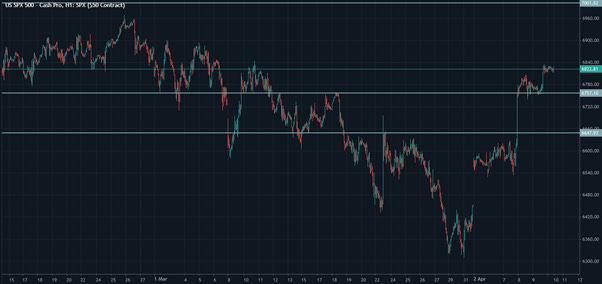
Gap risk is the specific hazard of holding positions into a weekend when a binary event with material market impact is occurring outside trading hours. The Islamabad talks between US and Iranian officials, which began Thursday night and are expected to continue through the weekend, represent exactly this category of event. The ceasefire runs for two weeks from Tuesday’s announcement. The talks in Islamabad are the primary mechanism through which those two weeks produce either a permanent settlement or a return to hostilities.
A deal announced over the weekend, with specific terms on military withdrawal and permanent Strait of Hormuz access, would open equity markets sharply higher on Sunday evening. The Nasdaq below 25,181 resistance would gap through that level. The S&P 500 above its 6,757 support would open toward the next structural target. European markets would follow. Oil would fall further from the levels already reduced by the ceasefire announcement.
A breakdown in talks, or an announcement that the two-week window has insufficient progress to avoid returning to conflict, would produce the opposite gap. The support at 6,757, which has held through the ceasefire period, would be tested immediately. The Nasdaq’s position below resistance would become a position threatening the lower levels from which Tuesday’s ceasefire surge launched.
The muted futures and expected trading hesitancy on Friday are the rational market response to holding those two potential outcomes simultaneously without knowing which will materialise. Traders who are hesitant to put on positions ahead of this weekend are making the appropriate risk management decision given the binary nature and the weekend timing of the primary variable.
US CPI March: The Conflict’s Inflationary Report Card
US CPI for March, due at 13:30, is the most significant economic data release of the conflict period for the US. March was the month in which oil averaged near $100, the Strait of Hormuz was closed, global shipping was disrupted, and consumer and corporate confidence was suppressed by an active military conflict. The CPI reading will quantify how much of that inflationary pressure arrived in actual consumer prices.
The forecast of 0.30% month-on-month is unchanged from the prior reading, and the year-on-year forecast of 2.30% represents a decline from the prior 2.40%. Core CPI month-on-month is forecast at 0.20%, also unchanged from prior. These forecasts imply that economists expect the conflict’s inflationary impact to be modest and contained, with headline CPI declining year-on-year rather than accelerating. If the forecasts are accurate, they would suggest that the energy cost transmission into consumer prices during March was less severe than the scale of the oil price increase might have implied.
There are specific reasons why the March CPI might print higher than forecast. Oil near $100 through much of March adds directly to petrol prices, transport costs, and energy components of the index. Those effects typically appear in CPI within weeks of the underlying commodity move. The eurozone’s Consumer Price Expectations reading of 43.4 against a 24.5 forecast earlier in the month suggested that households anticipated significant price increases. Whether the US CPI captures that anticipation in actual data or whether the inflationary pressure is still in transit through supply chains will be the reading’s primary analytical question.
A print above the 2.30% year-on-year forecast would add inflationary pressure to a Fed that has been signalling a tightening bias. In the context of the ceasefire, where the supply-side driver of inflation is being addressed, an elevated March CPI print might be treated as a backward-looking data point rather than a forward indicator, but it would nonetheless generate market volatility and complicate the Fed’s communication about its policy path.
Indices: Near the Levels That Matter
The S&P 500 is unchanged at 6,823, trading above the support line at 6,757 that has held throughout the post-ceasefire period. The support’s continued integrity through several sessions of modest profit-taking and geopolitical uncertainty confirms that buyers have been consistently willing to step in at that level, converting it from former resistance into genuine structural support. Whether it remains so through the weekend depends on the Islamabad outcome.
The Nasdaq 100 is up a marginal 0.03% at 25,088, holding below the 25,181 resistance level. The gap between the current price and resistance is approximately 93 points, narrow enough that a single positive session could bridge it, but wide enough that the market has not committed to closing it without a clearer positive signal. The commentary’s framing is precise: the market was slightly higher yesterday but still holding below. The Nasdaq is calibrated to the diplomatic outcome rather than moving on its own technical momentum.
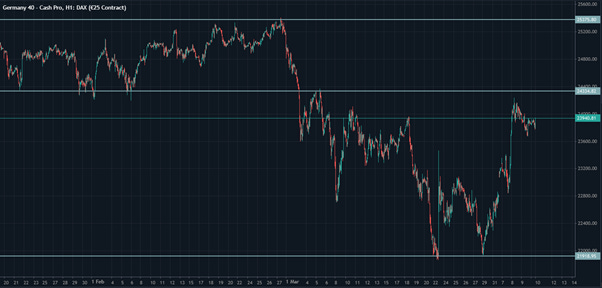
Germany 40 is up 0.65% and the FTSE is up 0.53%, both providing modest positive tones to the European session without the dramatic moves that characterised the immediate post-ceasefire sessions. The incremental improvement in European indices is consistent with a market that has partially priced the ceasefire’s benefits and is now calibrating further recovery to the outcome of the Islamabad talks.
EURUSD is fractionally higher at plus 0.09% and GBPUSD is up 0.03%, both continuing the gradual dollar softening that the ceasefire has set in motion without the urgency of the initial announcement’s repricing. USDJPY is marginally higher at plus 0.18%, reflecting the Bank of Japan’s tightening tension continuing to provide residual dollar support against the yen.
The Week in Review and What Next Week Requires
The week that began with markets hovering at resistance ahead of Tuesday’s deadline closes with markets holding above support after the most significant positive session of the conflict period. The transition from resistance-as-ceiling to support-as-floor is the week’s defining technical development. Tuesday’s ceasefire rally broke through six weeks of accumulated selling at the resistance level with a force that rewrote the market’s reference framework.
What next week requires, above the data schedule and earnings calendar, is progress from Islamabad that converts the two-week ceasefire into a credible path toward a permanent settlement. A deal with specific terms for military withdrawal, permanent Strait of Hormuz access, and resolution of the nuclear concerns that Trump cited as the operation’s objective would justify the Nasdaq breaking 25,181 and targeting the all-time high. A stalled or collapsed process would bring the conflict-period lows back into the analytical frame.
The week closes with the market in the most constructive technical position it has occupied since the conflict began, but with the primary variable, the diplomatic outcome, unresolved and generating gap risk for anyone holding positions into the weekend. The CPI data this afternoon will set the Fed’s inflationary context for whatever diplomatic outcome Monday brings. The two weeks of ceasefire have begun. The next thirteen days will tell the rest of the story.
The Bottom Line
Friday is a day for CPI data and risk management ahead of a weekend that carries more binary potential than most. Futures are muted, reflecting rational caution rather than fundamental concern. The S&P 500’s support at 6,757 is intact. The Nasdaq sits 93 points below the resistance that a deal would break. European indices are modestly positive.
March CPI at 13:30 is the session’s primary catalyst. A reading consistent with the 2.30% year-on-year forecast confirms that the conflict’s inflationary impact has been contained thus far. A reading above forecast adds a monetary policy complication to a diplomatic picture that has otherwise been improving.
The Islamabad talks are the weekend’s primary event. Whatever they produce will set the market’s tone for next week’s open. Position accordingly.
Lunaro is an execution-only service provider. This material is a marketing communication and is provided for general information and educational purposes only. It does not take into account your personal circumstances, objectives or needs. Any opinions are those of the author at the time of writing and may change without notice. Nothing in this material constitutes (or should be construed as) financial, investment, legal, regulatory or tax advice, or a recommendation to engage in any investment activity. You should not rely on this material when making investment or trading decisions.
This material has not been prepared in accordance with legal requirements designed to promote the independence of investment research and is not subject to any prohibition on dealing ahead of the dissemination of investment research. Lunaro may deal as principal and/or have an interest in the financial instruments or markets referred to in this material in the ordinary course of its business, including at or around the time of publication, and does not seek to take advantage of this material prior to its dissemination.
While reasonable care has been taken in preparing this material, no representation or warranty is made as to its accuracy or completeness and Lunaro accepts no liability for any loss arising from any use of, or reliance on, this material. Past performance is not indicative of future results.
CFDs are complex instruments and come with a high risk of losing money rapidly due to leverage. Approximately 80% of retail investor accounts lose money when trading CFDs with this provider. You should consider whether you understand how CFDs work and whether you can afford to take the high risk of losing your money.
Lunaro Financial Services Limited is authorised and regulated by the Financial Conduct Authority (FCA), Register No. 184333. Registered in England and Wales, No. 03148972.
Lunaro Markets Limited is authorised and regulated by the Financial Services Regulatory Authority (FSRA) of Abu Dhabi Global Market (ADGM), Financial Services Permission No. 200034, Registration No. 000005466.


Comments
Post a Comment