Market Intelligence Brief: Ceasefire Extended, Vance’s Trip Suspended, and UK Inflation Hits 3.3%
April 22, 2026 - Trump has extended the Iran ceasefire overnight, lifting futures off Tuesday’s lows. Vance’s trip to Islamabad has been suspended. The Strait stays closed. UK CPI has printed at 3.3% year-on-year, driven by conflict-related fuel costs. Tesla and Lam Research report after the close.
The ceasefire expiry that had been the week’s defining countdown has been averted, at least for now. Trump announced an extension to the Iran ceasefire overnight, lifting US futures off Tuesday’s lows and providing the partial recovery visible across European markets this morning. The diplomatic picture, however, remains fragile in ways that the extension alone cannot resolve. The Strait of Hormuz stays closed. The naval blockade continues until Tehran submits a formal proposal. Vance’s trip to Islamabad, which had been the intended next step in the negotiating process, has been suspended. Any talks this week appear unlikely. The ceasefire has been extended, but the mechanism for converting that extension into a permanent settlement has simultaneously become less accessible.
Wednesday’s session is a relief rally on a narrow basis: the binary event of ceasefire expiry has been removed from the immediate horizon, but the structural conditions that made the expiry a market risk remain in place. The Strait is closed. The blockade is enforced. Diplomacy is stalled. What has changed is the timeline, not the underlying situation.
The Ceasefire Extension: Relief With Conditions Attached
Ceasefire and diplomatic developments tracked via Investing.com.
The overnight extension of the ceasefire removes the most immediate market risk of the week but does so without addressing the substantive obstacles to a permanent settlement. The conditions attached to the continuation of the blockade, which require it to remain in place until Tehran submits a formal proposal, frame the extension as a pressure mechanism rather than a de-escalation. The US is not withdrawing pressure; it is allowing more time for that pressure to produce the Iranian response that would justify a shift in posture.
Vance’s suspended trip to Islamabad is the diplomatic dimension that qualifies the extension most significantly. A ceasefire extended without the talks mechanism that would give it purpose is a pause rather than a process. The Islamabad format was the agreed channel through which permanent settlement terms were to be negotiated. Its suspension means the extension buys time without the instrument, but it doesn’t use that time productively. Unless an alternative format is established quickly, the extended ceasefire risks becoming a holding pattern that expires on different terms rather than concluding in a deal.
For markets, the extension is the positive reading, and the Islamabad suspension is the moderating qualification. The net result is a partial recovery rather than the decisive positive session that a confirmed Pakistan talks restart would have produced. European indices opening modestly higher with uniform gains across bourses, characterised as macro relief rather than sector conviction, captures this dynamic precisely.
UK CPI at 3.3%: The Conflict’s Inflationary Footprint in Hard Data
UK inflation data sourced from Investing.com.
UK CPI for March has printed at 3.3% year-on-year, up from 3.0% in February, driven primarily by higher fuel costs stemming from the Middle East conflict. The reading is the clearest single piece of economic data to date that directly attributes the UK’s inflation acceleration to the conflict’s transmission of energy costs. Before the war, inflation was expected to ease; the 3.3% reading represents both a reversal of that trajectory and confirmation that the supply-side inflationary impulse from elevated oil and gas prices has now arrived in the official statistics.
The move from 3.0% to 3.3% in a single month, driven by fuel costs, is the type of reading that the Bank of England’s tightening bias was designed to address. Three weeks ago, the BoE was one of three major central banks signalling a hold with hawkish guidance. The 3.3% CPI print, with the conflict’s energy costs as the named primary driver, shifts the tightening bias from a forward-looking signal to a posture supported by current data. If the Strait remains closed and fuel costs remain elevated into April, the April CPI reading will add to the pressure rather than reduce it.
The specific attribution to conflict-related fuel costs is important for how the Bank of England assesses its policy options. Supply-side inflation driven by an external geopolitical event is the hardest category for monetary policy to address cleanly. Raising rates reduces demand but does not reopen the Strait of Hormuz. The BoE faces the same dilemma that the ECB and other central banks have been navigating: tighten to address the inflation symptom or hold to protect growth in an economy already absorbing significant external cost pressure.
US Futures: Holding the Sunday Open as Near-Term Support
US index futures data sourced from Investing.com.
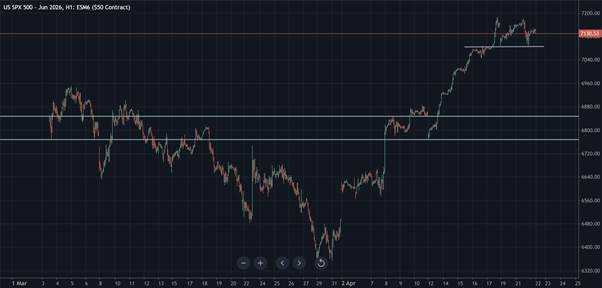
The S&P 500 is up 0.26%, the Nasdaq 100 is higher by 0.42%, and the Dow is up 0.24%. The Nasdaq’s relative outperformance continues its established pattern of leading the recovery on any reduction in inflationary and rate-tightening pressure. An extended ceasefire, even without active talks, reduces the probability of the conflict’s most severe escalation scenarios and provides marginal relief to rate expectations that have been constraining growth valuations.
The Sunday open level is acting as the key near-term reference for both indices. The S&P 500 is recovering from Tuesday’s sell-off back toward that level. The Nasdaq is similarly bouncing after Tuesday’s decline and holding around the Sunday open area. Both charts identify this level as the floor that determines whether the session represents a stabilisation or whether a break below it opens the door to further downside. Wednesday’s modest positive moves suggest stabilisation is the current base case, but the Vance suspension and the Strait’s continued closure mean the support is conditional rather than structural.
European Equities: Uniform Relief, Limited Conviction
European index data sourced from Investing.com.
European indices are opening modestly higher across the board: Germany 40 up 0.56%, France 40 up 0.65%, Euro Stoxx 50 up 0.52%, and the FTSE UK 100 up 0.51%. The uniformity of the gains is the analytically relevant feature. When every index moves by approximately the same amount in the same direction, the driver is macro sentiment rather than sector-specific or country-specific factors. A macro relief rally on ceasefire extension produces this kind of uniform moderate recovery.
The FTSE’s 0.51% gain sits alongside the UK’s 3.3% CPI print, an interesting juxtaposition. Higher inflation supports the energy sector’s earnings within the index whilst simultaneously signalling the rate pressure that weighs on other components. The net result for the FTSE is a gain broadly in line with European peers rather than either outperformance or underperformance, reflecting those offsetting factors in approximate equilibrium.
The DAX’s 0.56% gain is measured relative to the 1.35% loss on Monday, meaning the DAX has recovered less than half of Monday’s decline across Tuesday and Wednesday combined. Germany’s LNG supply chain exposure and industrial energy intensity mean the DAX will not fully recover until the Strait reopens, rather than merely the ceasefire being extended.
Tesla and Lam Research: Earnings Into the Relief Session
Earnings consensus data sourced from Investing.com.
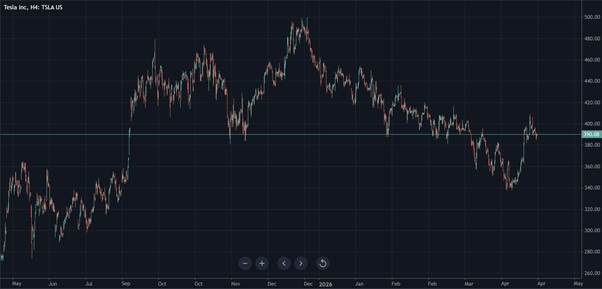
Tesla reports after the close, with consensus EPS of $0.30 on $22.17 billion in revenue, implying year-over-year revenue growth of approximately 15%. Deliveries missed estimates and energy storage deployments fell sharply quarter-on-quarter in Q1, making the gross margin picture and the guidance on the Robotaxi rollout the primary focus rather than the headline revenue figure. Tesla’s automotive gross margin has been under pressure from price cuts and competitive dynamics, and any improvement or stabilisation of that metric would be the most constructive element the results could provide.
The Robotaxi rollout progress is the longer-term narrative within the results. Tesla has been framing autonomous driving deployment as the next phase of its value proposition, and any concrete timeline or operational update on that programme would carry weight beyond the quarterly numbers in how investors assess the stock’s forward potential.
Lam Research reports EPS of $1.36, up approximately 31% year-on-year, on revenue of $5.76 billion, up approximately 22%. AI-driven semiconductor equipment demand is the primary tailwind, and year-over-year growth rates reflect the recovery in the semiconductor capital equipment cycle following a period of significant customer inventory correction. Lam’s results will be read alongside the Broadcom-Google seven-year deal announced earlier in the conflict period as further evidence of how sustained the AI infrastructure investment cycle is proving to be despite the geopolitical disruption of the past seven weeks.
The Bottom Line
Wednesday provides the partial recovery that the ceasefire extension justifies. Equity futures are modestly positive. European indices are uniformly higher on macro relief. UK CPI at 3.3% is the week’s most significant economic data point, directly attributing the inflation acceleration to conflict-related fuel costs and hardening the case for BoE tightening.
The diplomatic situation is extended rather than resolved. Vance’s suspension of Islamabad means the talks mechanism is absent even as the ceasefire continues. The Strait stays closed. The naval blockade is enforced pending Tehran’s formal proposal. Tesla and Lam Research report after the close, providing the technology and semiconductor sectors’ read-through on a period of conflict that has disrupted macro conditions but left the AI infrastructure investment cycle largely intact.
The Sunday open level is the near-term support to watch. The ceasefire’s new expiry date is the next countdown to set.
Lunaro is an execution-only service provider. This material is a marketing communication and is provided for general information and educational purposes only. It does not take into account your personal circumstances, objectives or needs. Any opinions are those of the author at the time of writing and may change without notice. Nothing in this material constitutes (or should be construed as) financial, investment, legal, regulatory or tax advice, or a recommendation to engage in any investment activity. You should not rely on this material when making investment or trading decisions.
This material has not been prepared in accordance with legal requirements designed to promote the independence of investment research and is not subject to any prohibition on dealing ahead of the dissemination of investment research. Lunaro may deal as principal and/or have an interest in the financial instruments or markets referred to in this material in the ordinary course of its business, including at or around the time of publication, and does not seek to take advantage of this material prior to its dissemination.
While reasonable care has been taken in preparing this material, no representation or warranty is made as to its accuracy or completeness and Lunaro accepts no liability for any loss arising from any use of, or reliance on, this material. Past performance is not indicative of future results.
CFDs are complex instruments and come with a high risk of losing money rapidly due to leverage. Approximately 80% of retail client accounts lose money when trading in CFDs. You should consider whether you understand how CFDs work and whether you can afford to take the high risk of losing your money.


Comments
Post a Comment