Hormuz Seizures, Stalled Talks, and Divided PMIs
23 April 2026
The relief that Wednesday’s ceasefire extension had briefly provided has been erased. Iran’s Revolutionary Guard attacked three cargo vessels in the Strait of Hormuz overnight and claims to have seized two of them. Tehran’s chief negotiator has declared that reopening the Strait is not possible, citing ceasefire breaches by the opposing side. The United States, for its part, has said there is no time pressure on ending the war. The combination of a fresh Hormuz escalation, a hardened Iranian negotiating posture, and a Washington response that refuses to communicate urgency has produced the session’s dominant tone: risk-off across equities, energy names bucking the trend on rising oil, and diplomacy that now appears firmly stalled rather than merely paused.
The one partial offset to the deteriorating geopolitical picture is that Israel and Lebanon are due to hold a second round of talks in Washington today, with Secretary Rubio participating. That process runs on a separate track from the Iran ceasefire framework and carries its own dynamics, but it is the single constructive diplomatic signal in an otherwise heavily negative morning for the macro picture.
Flash PMIs across Europe and the United States provide the session’s economic context. The UK picture was firm, with manufacturing and services both above forecast. The eurozone picture was split, with manufacturing recovering but services falling short in a way that carries implications for the ECB’s rate path. US flash PMIs are due this afternoon.
The Strait Escalation: From Extension to Attack
Geopolitical and conflict developments sourced from Investing.com.
Wednesday’s ceasefire extension was, at best, a timeline reset rather than a resolution. Thursday morning has confirmed the fragility of that framing. The IRGC’s overnight attack on three cargo vessels in the Strait of Hormuz, with Tehran claiming to have seized two of them, represents a qualitative escalation beyond the blockade that had been the defining feature of the prior seven weeks. A blockade enforces a closure through the threat of force. Seizures of commercial vessels are acts of force. The distinction matters for how the international shipping community, insurance markets, and the naval forces operating in the region will now assess the risk calculus of transit through or near the Strait.
Tehran’s chief negotiator declaring that reopening the Strait is not possible, citing ceasefire breaches, provides the diplomatic framing for the escalation. Whether or not those cited breaches constitute a genuine legal or procedural basis for the action is secondary to the market-relevant question, which is whether this development moves the timeline for a Strait reopening closer or further away. The answer, on the available evidence, is further away. The Iranian negotiating posture has shifted from conditional resistance to active justification of continued closure. The Washington response of stating that there is no time pressure on ending the war compounds the signal. Two parties, each communicating that the current situation is sustainable from their own perspective, are not parties that are converging toward a settlement.
The suspension of Vance’s Islamabad trip, announced on Wednesday, has now been followed by a morning on which the conditions for restarting that process have deteriorated rather than improved. A ceasefire that was extended without a talks mechanism is now a ceasefire whose underlying temperature has risen. The market has repriced accordingly.
Equities and US Futures: Risk-Off Across the Board
European index and US futures data sourced from Investing.com.
European indices are opening lower across the board. The FTSE 100 is down 0.78%, the Euro Stoxx 50 down 0.84%, the Germany 40 down 0.65%, and the France 40 down 0.32%. The breadth of the decline, covering every major European bourse, is consistent with a macro-driven sell-off rather than anything sector-specific or country-specific. The driver is the overnight Hormuz escalation, and the uniform direction of the losses reflects that a geopolitical risk factor of this kind does not discriminate between markets.
The one notable exception within the broader equity picture is energy names, which are bucking the downward trend on the back of rising oil prices. That pattern has been a consistent feature of this conflict period. When Strait risk intensifies, oil rises and energy sector equities diverge from the broader market direction. It does not constitute an equity market positive in any meaningful sense, since the energy sector gains are more than offset by the losses across other sectors, but it is the internal rotation that characterises this specific type of geopolitical shock.
US futures are carrying the same direction. The S&P 500 is down 0.45%, the Nasdaq 100 off 0.68%, and the Dow down 0.25%. The Nasdaq’s relative underperformance reflects a pattern that has appeared consistently throughout the conflict period: when rate expectations tighten or geopolitical risk intensifies in ways that raise the probability of a more prolonged elevated-rate environment, technology and growth valuations bear the largest adjustment. The Nasdaq’s larger decline relative to the Dow captures that rate-sensitivity channel operating in real time.
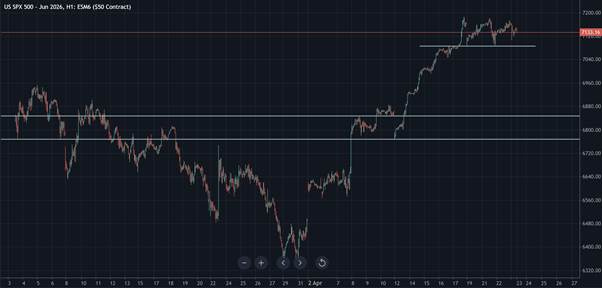
The prior consolidation area is the nearest support reference for both indices. Whether Thursday’s session holds that level or breaks below it will depend in part on how the US PMI data prints this afternoon and whether any diplomatic development out of the Israel-Lebanon Washington talks provides an offset to the Hormuz deterioration. The base case, given the morning’s data, is that support is under pressure rather than comfortably defended.
Flash PMIs: A Divided Picture Across the Atlantic
Economic data sourced from Investing.com.
Flash PMIs for April provide the session’s principal economic data points, and the picture across geographies is divided in ways that carry distinct policy implications. The UK reading was the most constructive of the morning’s European prints. UK manufacturing came in at 53.6 and services at 52.0, both above the prior reading and above forecast. A manufacturing print above 50 indicates expansion, and a services reading in the same territory confirms that the UK economy is growing on both dimensions entering the second quarter. Given that UK CPI printed at 3.3% year-on-year in March, driven by conflict-related fuel costs, the combination of above-forecast PMIs and elevated inflation maintains the Bank of England’s tightening case on both the demand and the inflation sides of the ledger simultaneously.
The eurozone picture is more complicated. Manufacturing came in at 52.2, which represents a recovery into expansionary territory and is the more constructive of the two eurozone readings. Services, however, disappointed materially, printing at 47.4 against a forecast of 49.8. A services reading below 50 indicates contraction, and the miss relative to expectations is significant. Germany’s services PMI also missed, printing at 46.9. The services sector accounts for the majority of eurozone GDP and employment, and readings in contraction territory in the eurozone’s two largest economies reinforce the growth concern that has been running alongside the inflation concern throughout the conflict period.
For the ECB, the services disappointment is the reading that complicates the policy calculus most directly. The ECB has been navigating the same dilemma as the Bank of England: tighten to address supply-side inflation or hold to protect growth that is already under external pressure from elevated energy costs. A services sector in contraction territory, combined with the renewed Hormuz escalation adding to those energy cost pressures, shifts the balance of that dilemma in the direction of caution rather than action. The manufacturing recovery is a partial offset, but services-led weakness in Germany and the broader eurozone is not a backdrop against which the ECB’s tightening advocates can easily build consensus.
US flash PMIs are due this afternoon and will be the final major data point of the session. Given the morning’s geopolitical developments, the US data will be read partly as a barometer of how much the conflict’s energy cost transmission has affected US economic activity in April, and partly as a test of whether US growth resilience, which has been a consistent feature of the conflict period so far, is beginning to show signs of wear.
Intel and American Express: Earnings Into an Escalation Session
Earnings consensus data sourced from Investing.com.
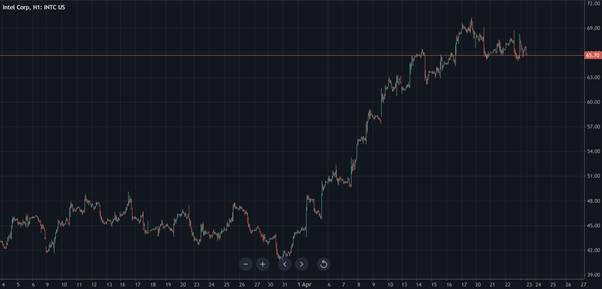
Intel reports with consensus EPS of $0.01 on revenue of $12.40 billion, representing a year-on-year revenue decline of 2.10%. The headline numbers are not the primary focus. The questions that matter for Intel’s forward assessment are the Data Centre and AI segment momentum, the progress on 18A process node yields, and the trajectory of margin recovery. Intel’s strategic position during this conflict period has been shaped by the AI infrastructure investment cycle, which has remained structurally intact despite broader geopolitical disruption. Whether Intel is participating meaningfully in that cycle, or whether its foundry and data centre segments are gaining or losing ground relative to the competition, will determine how the market reads results that the headline EPS figure alone does not illuminate.
The 18A process node is the hinge on which Intel’s foundry ambitions turn. Yield progress on that node is the single most operationally significant disclosure Intel could make, and any indication that the ramp is proceeding according to plan, or is behind it, will carry more weight for the medium-term assessment of the stock than the quarterly financial summary.
American Express reports consensus EPS of $4.00, up 9.89% year-on-year, on revenue of $18.61 billion, up 9.69%. American Express functions as a bellwether for premium consumer spending and for the resilience of travel and entertainment demand. In a period defined by conflict-driven inflation and central bank tightening bias, the company’s results provide a read on whether the cardholder base that drives Amex’s revenue is absorbing those cost pressures without meaningful credit deterioration. Commentary on cardholder credit quality will be the most closely watched element of the results. If delinquencies are rising or spending growth is decelerating in ways that outpace what the consensus already expects, that read-through extends well beyond Amex to the broader consumer picture.
Travel and entertainment spending trends are also relevant given the conflict’s effect on aviation fuel costs and international travel patterns. Whether the Amex cardholder base, which skews toward premium travel, is adjusting behaviour in response to elevated travel costs is a question the results will at least partially answer.
Bottom Line
Thursday’s session opens with the geopolitical picture materially worse than Wednesday’s close. The IRGC’s overnight attacks on cargo vessels in the Strait of Hormuz and Tehran’s declaration that reopening the Strait is not possible have moved the conflict from a ceasefire-extension holding pattern into active escalation. European indices are uniformly lower. US futures are in the red, with the Nasdaq underperforming on rate sensitivity. Energy names are the session’s exception, rising with oil.
Diplomacy is stalled at the Iran level. The Israel-Lebanon Washington talks are the session’s one constructive diplomatic signal, though they operate on a separate track. UK flash PMIs were firm; eurozone services disappointed materially. US PMIs are due this afternoon. Intel and American Express report today, providing earnings colour in a session where macro risk is the dominant driver.
The prior consolidation area is the support reference to watch on the indices. The Strait’s status, after overnight’s seizures, is the geopolitical variable that now carries more market weight than the ceasefire timeline alone.
Lunaro is an execution-only service provider. This material is a marketing communication and is provided for general information and educational purposes only. It does not take into account your personal circumstances, objectives or needs. Any opinions are those of the author at the time of writing and may change without notice. Nothing in this material constitutes (or should be construed as) financial, investment, legal, regulatory or tax advice, or a recommendation to engage in any investment activity. You should not rely on this material when making investment or trading decisions.
This material has not been prepared in accordance with legal requirements designed to promote the independence of investment research and is not subject to any prohibition on dealing ahead of the dissemination of investment research. Lunaro may deal as principal and/or have an interest in the financial instruments or markets referred to in this material in the ordinary course of its business, including at or around the time of publication, and does not seek to take advantage of this material prior to its dissemination.
While reasonable care has been taken in preparing this material, no representation or warranty is made as to its accuracy or completeness and Lunaro accepts no liability for any loss arising from any use of, or reliance on, this material. Past performance is not indicative of future results.
CFDs are complex instruments and come with a high risk of losing money rapidly due to leverage. Approximately 80% of retail client accounts lose money when trading in CFDs. You should consider whether you understand how CFDs work and whether you can afford to take the high risk of losing your money.
Lunaro Financial Services Limited is authorised and regulated by the Financial Conduct Authority (FCA), Register No. 184333. Registered in England and Wales, No. 03148972.
Lunaro Markets Limited is authorised and regulated by the Financial Services Regulatory Authority (FSRA) of Abu Dhabi Global Market (ADGM), Financial Services Permission No. 200034, Registration No. 000005466.


Comments
Post a Comment