Market Intelligence Brief: Yesterday’s Rally Reversed as “Hit Hard” Follows “Leaving Very Soon”
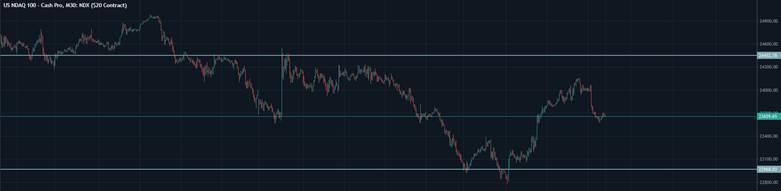
April 2, 2026 - Trump’s speech stating the US will hit Iran hard over the next two to three weeks has reversed Tuesday’s rally. The Nasdaq failed to test its resistance level. Futures are lower across the board. The seesaw continues.
The market received the answer to the question posed at yesterday’s close: whether “leaving very soon” would be followed by confirmation or revision. The answer has arrived as a revision. In a speech on Wednesday, Trump stated that the US would hit Iran hard over the next two to three weeks in an attempt to prevent Tehran from obtaining a nuclear weapon. Tuesday’s equity rally, driven by the most decisive withdrawal signal of the conflict period, has given way to Thursday morning’s broad-based decline. The Nasdaq failed to test its resistance level before reversing. US futures are lower across the board. The dollar has strengthened overnight, with GBPUSD trading approximately 100 pips lower since midnight.
The characterisation of equity futures seesawing as Trump sends mixed messages each day is precise and requires no embellishment. The conflict has now produced an identifiable and repeating market structure: a decisive signal in one direction drives a meaningful move, that signal is contradicted or revised within twenty-four to forty-eight hours by an equally decisive signal in the other direction, and the net result is a market that ends each cycle either flat or fractionally lower without establishing any durable directional structure.
“Hit Hard Over Two to Three Weeks”: What the Signal Actually Says
The content of Trump’s Wednesday speech is more analytically significant than simply the fact that it reversed Tuesday’s rally. Stating that the US will hit Iran hard over the next two to three weeks provides a specific timeline that was notably absent from every previous characterisation of the conflict’s duration. “Several more weeks” from Israel earlier in the conflict was one such specific signal. Two to three weeks from the US President is another.
The nuclear weapons rationale that Trump cited as the objective adds a new stated justification for continuing operations that had not previously been given explicit prominence. Whether this reflects a genuine shift in the stated goals of the operation, an attempt to construct a more defensible rationale for continued military engagement, or a messaging strategy aimed at maintaining domestic and international support for the conflict is not knowable from the outside. What is clear is that a stated US intention to conduct intensive military operations for the next two to three weeks is inconsistent with the “leaving very soon” signal that drove Tuesday’s gains.
The market’s response, a decline rather than the sharp selloff that the signal might have warranted in the conflict’s early weeks, reflects the accumulated calibration effect of five weeks of contradictory signals. Moves that would have produced dramatic single-session declines in early March are now producing contained pullbacks. The 1.49% Nasdaq decline and the 1.14% S&P 500 fall are significant but measured, consistent with a market that is pricing the contradiction without panic. The lack of momentum noted in this morning’s analysis captures the same dynamic: participants are unwilling to commit fully to either direction when the primary driver is a communication pattern that has reversed itself multiple times in a week.
The Resistance Level That Was Not Tested
The Nasdaq’s failure to test the resistance level identified in Tuesday’s and Wednesday’s commentary is the most significant technical observation of Thursday’s session. Tuesday’s rally brought the index close to that level without reaching it. Wednesday evening’s reversal on the “hit hard” speech prevented the test from occurring and sent the index back toward its recent range. The pattern that has defined the Nasdaq through the conflict period, lower lows and lower highs, remains intact. The higher high that would have signalled a potential trend change has not been recorded.
The technical significance of failing to test a resistance level before reversing is specific: it suggests that the buying pressure driving Tuesday’s rally was insufficient to overcome the selling pressure concentrated at that level. Either sellers at the resistance were prepared to act, or the “hit hard” news arrived before the index could reach it, or the volume and conviction behind Tuesday’s buying were insufficient to drive through. In the current environment, the third explanation is most consistent with the observation that the moves lack momentum.
Further confirmation of escalation, as the commentary identifies, could send the index back to Tuesday’s low. If that low is breached, the lower lows pattern extends, and the Nasdaq operates in territory below the level that provided support during the bounce from 23,000. The conditional nature of that scenario, dependent on further confirmation of escalation rather than another de-escalation signal, reflects the fundamental unpredictability of the conflict’s communication pattern.
European Equities: DAX Reverses, FTSE Holds Its Shoulder
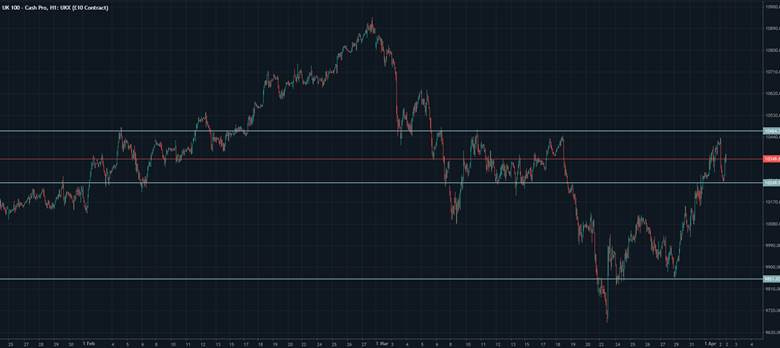
Germany 40 is down 1.65%, reversing a significant portion of Tuesday’s 2.55% gain. The DAX has tested the 10,465 shoulder level on the FTSE and, with the US selloff weighing on European markets, is pulling back from Tuesday’s peak. The scale of the reversal is smaller than Tuesday’s advance, which means the week’s net move for the DAX remains marginally positive despite Thursday’s decline. However, the broader conflict-period downtrend has not been reversed.
The FTSE is flat at-0.02%, with the index testing the shoulder level identified earlier in the week. The FTSE’s relative strength compared to other European futures continues to reflect two factors: the energy sector’s partial hedge against oil-related news, and sterling’s relative stability amid the broader dollar-strengthening move. GBP holding steadier than EUR against the strengthening dollar provides the FTSE with currency support that continental European indices do not.
EURUSD is down 0.56%, and GBPUSD is down 0.81%, with GBPUSD moving approximately 100 pips lower since midnight. The dollar’s overnight strengthening reflects the reassertion of safe-haven demand following the “hit hard” speech, reversing the partial unwind of the safe-haven premium that EURUSD’s break above 1.1600 on Wednesday had begun. The resistance at 1.1600, which was broken to the upside on Wednesday, was retested from below on Thursday as the signal reversal brought the dollar back to bid.
Initial Jobless Claims: The Labour Market Data in Focus
Initial Jobless Claims for the week ended March 28th are due at 13:30, with a forecast of 211,000 against a prior of 210,000. The near-flat forecast implies continued stability in the weekly claims picture. In the context of yesterday’s ADP Employment Change data, which carried the clearest employment signal for the conflict period, the claims reading will be assessed as part of a developing series rather than as an isolated data point.
A reading close to 211,000, consistent with the forecast, would maintain the picture of a labour market that is absorbing the conflict’s economic pressures without yet showing structural deterioration. The directional concern, as noted across multiple sessions, is whether each week’s claims reading is the beginning of a rising trend or a stable range. Thursday’s reading will be one more data point in that assessment.
No major earnings are scheduled today. The session belongs to the conflict’s signal reversal and the claims data. Between the two, the conflict’s communications remain the dominant variable. The economic calendar provides context; it does not determine direction in an environment where a single presidential speech can reverse a day’s worth of equity gains.
The Seesaw: A Pattern Now Defining April as It Defined March
The seesawing character of this week captures in miniature the pattern that defined the final weeks of March. Tuesday’s “leaving very soon” maps onto the March 25th peace plan rally. Wednesday evening’s “hit hard” maps onto the mixed messaging reversal that followed each of those rallies. The difference this week is that the reversals are occurring within a single day rather than across two or three days, compressing the pattern’s cycle.
A market that seesaws within a day rather than over multiple days is pricing each signal without committing to the underlying directional assessment it would imply. Tuesday’s buyers did not hold their positions into Wednesday. Wednesday’s sellers are not committing to a sustained decline. Both are responding to communications without positioning for the continuation of those communications implies. This is the rational behaviour of a market that has learned, through repeated experience, that the continuation of any given signal is not reliably predictable in this conflict.
The implication for investors is one that the commentary has been building toward across the past several weeks: a market that moves on signals without the momentum to sustain them is not a market in which directional positioning carries a reliable expected return. It is a market in which waiting for confirmation before committing to a direction, however frustrating given the scale of the moves, is the approach most consistent with the information environment. The hard facts that would justify a committed directional position have not yet arrived, and until they do, the seesaw is the market’s most honest expression of where certainty stands.
The Bottom Line
Thursday reverses Wednesday’s reversal. The US will hit Iran hard over the next two to three weeks, according to Trump’s Wednesday speech, providing the latest contradiction in a communication pattern that has now produced a daily oscillation between withdrawal optimism and escalation commitment. The Nasdaq failed to test its resistance level before reversing. US futures are lower, while European equities are mixed, with the FTSE holding its ground on relative currency support and the DAX giving back some of Tuesday’s gains. The dollar’s safe-haven premium, which began to unwind on Wednesday, has reasserted overnight.
Initial Jobless Claims provide the session’s only scheduled data. No earnings. The seesaw continues, and the market’s lack of momentum in either direction is the clearest available signal of where participant conviction currently sits: suspended between contradictory signals that emerge daily, waiting for the hard evidence that would justify moving beyond provisional positioning in either direction.
Lunaro Financial Services Limited (trading as ‘Lunaro’) is an execution-only service provider. This material is a marketing communication and is provided for general information and educational purposes only. It does not take into account your personal circumstances, objectives or needs. Any opinions are those of the author at the time of writing and may change without notice. Nothing in this material constitutes (or should be construed as) financial, investment, legal, regulatory or tax advice, or a recommendation to engage in any investment activity. You should not rely on this material when making investment or trading decisions.
This material has not been prepared in accordance with legal requirements designed to promote the independence of investment research and is not subject to any prohibition on dealing ahead of the dissemination of investment research. Lunaro may deal as principal and/or have an interest in the financial instruments or markets referred to in this material in the ordinary course of its business, including at or around the time of publication, and does not seek to take advantage of this material prior to its dissemination.
While reasonable care has been taken in preparing this material, no representation or warranty is made as to its accuracy or completeness and Lunaro accepts no liability for any loss arising from any use of, or reliance on, this material.
Approximately 80% of retail investor accounts lose money when trading CFDs with this provider. You should consider whether you can afford to take the high risk of losing your money


Comments
Post a Comment