Market Intelligence Brief: Islamabad Talks Begin Tonight, Markets Settle Into the Ceasefire's Holding Pattern
April 9, 2026 - US and Iran talks are expected to begin in Islamabad from Thursday night. Markets have been subdued since Tuesday's rally, with profit-taking pulling futures modestly lower. The S&P 500 is testing whether its old resistance has become new support. GDP, Core PCE, and Initial Jobless Claims are all due this afternoon.
The day after the day after the ceasefire carries its own specific character. Tuesday night's rally was the most decisive positive session of the conflict period. Wednesday saw some profit-taking as participants reduced positions established in the surge. Thursday opens in the same subdued register, with US futures marginally lower and markets settling into the holding pattern that will define the next two weeks until the ceasefire's terms either convert to a permanent settlement or expire. The next meaningful catalyst has been identified: talks between US and Iranian officials in Islamabad, expected to begin from Thursday night. Until those talks produce something reportable, global markets are in a state of informed waiting.
Trump's emphasis that there will be no military withdrawal without a real deal provides the framing for how the two-week window should be assessed. The ceasefire was not a concession of strategic objectives; it was a defined pause within which diplomatic progress is expected to occur. A deal that satisfies both parties on substance remains the precondition for the withdrawal that the market priced on Tuesday night. If the Islamabad talks produce early positive signals, the recovery can extend. If they stall or produce the kind of contradictory messaging that characterised six weeks of conflict communications, the market's newly established technical levels will be tested from below.
Resistance Becomes Support: The Technical Test That Defines the Week
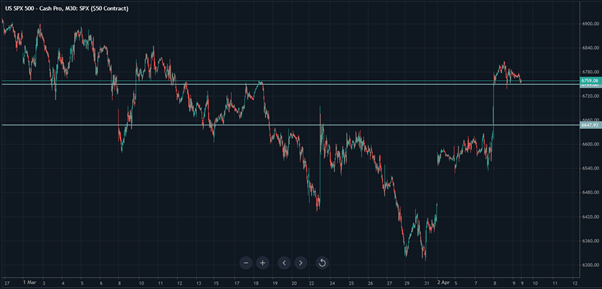
The S&P 500 is down 0.33% at 6,760, positioned at the level that was resistance throughout the conflict period's recovery attempts. The transition from resistance to support is one of the most important technical developments that follows any major break higher: a level that concentrated selling interest on the way up becomes, once broken convincingly, a level that concentrates buying interest on the way down. Whether it performs that function in practice depends on whether the fundamental conditions that justified the break remain in place.
The fundamental condition that justified Tuesday's break was the ceasefire and Strait reopening. Those conditions remain in place on Thursday morning. The Strait is open. The ceasefire is active. Talks are beginning tonight in Islamabad. Nothing has reversed the primary catalyst. The modest pullback from Tuesday's highs is profit-taking within a new fundamental context rather than a reassessment of that context.
If the Islamabad talks produce positive early results, the previous resistance at the current S&P level acts as the floor from which the next leg of recovery launches. If tensions arise or the talks produce the familiar contradictory messaging, the market could ignore the level and resume its conflict-period pattern of support levels yielding to fundamental pressure. The binary character of the outcome remains the defining feature, now expressed within a tighter technical range and a shorter defined timeframe than the previous six weeks provided.
The Nasdaq 100 is similarly down 0.33%, sitting just below the resistance at approximately 25,180. The commentary identifies the path clearly: a deal reached means a break through 25,180 and a trajectory toward all-time highs. The distance from 24,833 to all-time highs, above 26,000, represents the full recovery of the conflict period's losses and then some, a move that would only be justified by a comprehensive and credible permanent settlement rather than the conditional two-week arrangement currently in place.
European Equities: DAX Giving Back, FTSE Holding
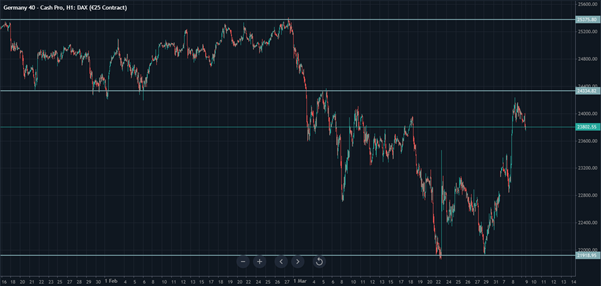
Germany 40 is down 0.94% after Tuesday's extraordinary 4.47% gain. The DAX's larger pullback relative to the FTSE reflects the same asymmetric logic that has characterised the index throughout the conflict period: higher amplitude moves in both directions, driven by Germany's structural exposure to the conflict's energy and supply chain consequences. A 0.94% consolidation after a 4.47% surge is proportionate and does not represent any meaningful reversal of Tuesday's advance.
The FTSE UK 100 is essentially flat at minus 0.06%, continuing to demonstrate the resilience that has characterised the index throughout the conflict. The FTSE's partial natural hedge from its energy sector composition now operates in a different mode: oil prices declining on the ceasefire benefit the economy broadly, but reduce the specific earnings support that the major oil producers had been providing to the index during the conflict's high-oil phase. The FTSE's near-flat reading reflects those offsetting forces in rough equilibrium.
Foreign Exchange: Dollar Softening Continues Gradually
EURUSD is up 0.13% at 1.16775, GBPUSD is higher by 0.12% at 1.34103, and USDJPY is marginally firmer at plus 0.25% at 158.98. The FX market's gradual and contained moves are consistent with a currency environment that priced a significant portion of the safe-haven unwind in Tuesday's surge and is now moving incrementally in the same direction as the fundamental picture continues to improve, without the urgency that the ceasefire announcement generated.
The dollar's residual strength in USDJPY, even as EURUSD and GBPUSD push marginally higher, reflects the Bank of Japan's tightening bias providing yen-weakening pressure that partially offsets the dollar softening dynamic. The tension between the dollar's declining safe-haven premium and the yen's own fundamental weakness has been one of the more consistent features of the conflict period's FX picture. With the conflict's resolution moving toward the diplomatic track, the BoJ's policy direction becomes a more dominant driver of USDJPY than the geopolitical safe-haven flows that had been setting the pair's direction for six weeks.
The Afternoon Data: GDP, Core PCE, and Claims
The afternoon data schedule is among the more consequential of the conflict period, carrying three major US releases simultaneously at 13:30. Core PCE Price Index for February is forecast at 0.40% month-on-month and 2.90% year-on-year, against a prior of 0.40% and 3.10% respectively. The year-on-year forecast of 2.90% represents a decline from the 3.10% prior, and the February timing means the reading captures the pre-conflict baseline rather than the conflict's inflationary impact.
GDP for Q4 is forecast at 0.70% quarter-on-quarter, matching the prior. GDP Sales for Q4 is also forecast at 0.40%, unchanged from the prior. These readings will confirm the economic backdrop against which the conflict occurred rather than measuring its impact, but they provide the foundational context for assessing how strong the US economy was entering a period of significant geopolitical disruption.
Initial Jobless Claims for the week ended April 4th are forecast at 206,000 against a prior of 202,000. The modest rise in the forecast is consistent with the directional concern noted across the conflict period: whether each week's claims reading represents a rising trend that reflects the conflict's employment impact, or a stable range consistent with a resilient labour market. A reading close to 206,000 would not resolve that question but would add one more data point to the emerging picture.
The 30-Year Bond Auction at 18:00 will follow the data and will be assessed in the context of whatever the afternoon's GDP and PCE readings produce. The prior yield of 4.87% on the 30-Year reflects the conflict period's tightening bias. A successful auction at a lower yield would confirm that the bond market is incorporating the ceasefire's inflationary reprieve in the same direction as equities and currencies.
Islamabad: What the Talks Need to Produce
The talks beginning in Islamabad tonight carry specific expectations that the preceding six weeks of failed or contradictory diplomatic signals have shaped. The market's current positioning, modestly below Tuesday's highs but well above the conflict-period lows, implicitly prices a meaningful probability of successful talks. A talks process that fails to produce early signs of progress toward the permanent settlement that would justify military withdrawal will test that pricing.
Specific areas where early signals from Islamabad would be market-relevant: any indication that both parties are engaging with each other's frameworks rather than simply restating maximalist positions; any mention of the specific issues on which progress has been made rather than general characterisations of the atmosphere; and any confirmed timeline for follow-up contacts that suggests the process has momentum beyond a single meeting.
The absence of progress in talks does not automatically return the market to conflict-period conditions, because the ceasefire itself remains in place and the Strait is open. But stalled talks that produce the familiar contradictory statements would reduce the probability premium currently embedded in equity prices and apply pressure to the support levels that Tuesday's surge has established.
The Bottom Line
Thursday is the market in informed waiting mode. Islamabad talks begin tonight. The ceasefire holds. The Strait is open. Equity futures are marginally lower on profit-taking that is proportionate to Tuesday's extraordinary gains. The S&P 500 is testing whether its old resistance has become new support, the Nasdaq sits below the 25,180 level that a deal would break, and the DAX consolidates after Europe's strongest single-session gain of the conflict period.
The afternoon provides GDP, Core PCE, and Initial Jobless Claims, all of which establish the economic baseline at the moment the conflict entered its ceasefire phase. The 30-Year Bond Auction will test whether the bond market's inflation expectations are adjusting in the same direction as every other asset class.
The next significant market move belongs to Islamabad. Until the talks produce something reportable, the market sits at levels established by Tuesday's ceasefire rally and waits, as it has been waiting for six weeks, for the hard evidence that determines its next direction.
Lunaro is an execution-only service provider. This material is a marketing communication and is provided for general information and educational purposes only. It does not take into account your personal circumstances, objectives or needs. Any opinions are those of the author at the time of writing and may change without notice. Nothing in this material constitutes (or should be construed as) financial, investment, legal, regulatory or tax advice, or a recommendation to engage in any investment activity. You should not rely on this material when making investment or trading decisions.
This material has not been prepared in accordance with legal requirements designed to promote the independence of investment research and is not subject to any prohibition on dealing ahead of the dissemination of investment research. Lunaro may deal as principal and/or have an interest in the financial instruments or markets referred to in this material in the ordinary course of its business, including at or around the time of publication, and does not seek to take advantage of this material prior to its dissemination.
While reasonable care has been taken in preparing this material, no representation or warranty is made as to its accuracy or completeness and Lunaro accepts no liability for any loss arising from any use of, or reliance on, this material. Past performance is not indicative of future results.
CFDs are complex instruments and come with a high risk of losing money rapidly due to leverage. Approximately 80% of retail investor accounts lose money when trading CFDs with this provider. You should consider whether you understand how CFDs work and whether you can afford to take the high risk of losing your money.
Lunaro Financial Services Limited is authorised and regulated by the Financial Conduct Authority (FCA), Register No. 184333. Registered in England and Wales, No. 03148972.
Lunaro Markets Limited is authorised and regulated by the Financial Services Regulatory Authority (FSRA) of Abu Dhabi Global Market (ADGM), Financial Services Permission No. 200034, Registration No. 000005466.


Comments
Post a Comment