Market Intelligence Brief: Duelling Peace Plans, Extended Deadlines, and a Market Running on Bluster
March 27, 2026 - The US 15-point plan has been described as resembling a surrender document. Iran has countered with a 5-point plan that the US will not accept. Another Trump deadline has been extended. Neither side has an exit plan. Markets are near flat, held up more by presidential rhetoric than by hard facts.
The week closes with a diplomatic picture that is simultaneously more developed and less hopeful than it appeared at Wednesday’s open. The existence of a 15-point peace plan, which drove the week’s most significant rally, has been contextualised by leaks describing it as a document so favourable to US and Israeli terms that it functions more as a demand for capitulation than a basis for negotiation. Iran’s counter-proposal, a 5-point plan that the US will not accept, confirms that both parties are transmitting positions rather than engaging in the give-and-take that precedes settlement. Another Trump deadline has been extended, eroding whatever deterrent value the original deadline carried. Markets are near flat on Friday morning, described as held up by Trump’s bluster rather than hard facts. From the sidelines, the honest assessment is that this conflict is in for the long haul, with neither side possessing a clear long-term plan or a credible exit.
The Peace Plans and What They Reveal
The 15-point plan the US handed to Iran, details of which have emerged through leaks, is described as resembling a surrender document: a set of terms so comprehensively favourable to the US and Israeli position that no government with remaining sovereignty and intact command structure would accept them as the basis for negotiation. The characterisation illuminates why Iran’s military spokesman dismissed the US as negotiating with itself. From an Iranian perspective, receiving a document that amounts to a set of demands rather than a framework for mutual concession is not a peace plan; it is an ultimatum.
Iran’s counter-proposal of a 5-point plan is equally revealing in the other direction. A 5-point response to a 15-point demand is a statement of priorities and limits rather than a comprehensive negotiating framework. The US will not accept Iran’s 5-point plan, according to this morning’s assessment, for the same reason Iran would not accept the 15-point plan: the gap between the two parties’ starting positions is wide enough that both sets of terms reflect aspirational outcomes rather than negotiating realities.
The duelling peace plans confirm that both sides are engaged in a process, but not yet in the kind of process that produces settlements. The pattern of conflicts that conclude through negotiation typically involves an extended period in which incompatible opening positions are gradually revised toward a zone of mutual acceptability. That zone does not currently exist. What exists is a US plan that resembles capitulation demands and an Iranian response that the US will not accept. The circus characterisation is precise: there is movement, performers, and noise, but there is no forward progress toward the exit.
Extended Deadlines and Eroded Credibility
Trump’s extension of another deadline is the third or fourth element of the week’s diplomatic picture that reduces rather than enhances the credibility of the US negotiating posture. A deadline that is extended rather than enforced is a deadline in name only. The psychological and strategic purpose of a deadline is to impose a cost on the party that misses it, creating an incentive to reach an agreement before the deadline passes. When deadlines are consistently extended, the party facing them learns that extension is available and that the deadline is negotiating leverage rather than a firm commitment.
In markets, the pattern of extended deadlines suggests that Trump’s bluster is the primary support mechanism for asset prices rather than substantive progress. Each deadline extension provides a brief period of uncertainty followed by relief when the extension is announced. Still, the net effect is a gradual erosion of the credibility of US negotiating commitments. A market that has watched multiple deadlines extended without consequence will discount the next deadline proportionally, reducing short-term volatility around deadline dates but also weakening the positive signal that a deadline approaching a genuine resolution would otherwise provide.
The observation that even the most hardline believers are now questioning whether the deadlines were ever real is an important marker of where credibility stands. When the US administration’s most sympathetic observers are openly sceptical of its strategic commitments, the diplomatic posture has moved from assertive to theatrical, and markets are adjusting their weighting of US signals accordingly.
Neither Side Has an Exit Plan
The most consequential analytical observation in Friday’s session is the simplest: neither side has a clear long-term plan, nor an exit plan. Five weeks into an active military conflict, with energy prices elevated, global markets disrupted, domestic political pressures building, and a diplomatic process producing incompatible proposals rather than convergence, the absence of an exit plan on either side is a genuinely alarming strategic situation.
Exit plans define the conditions under which an operation concludes, the mechanisms for achieving them, and the minimum acceptable outcome that justifies the costs incurred. Their absence at week five suggests either that the architects expected a swift military conclusion, making one unnecessary, or that the plan exists but its preconditions have not been met.
The Iranian regime is intact. The Strait remains selectively open. The US 15-point plan has been countered with an incompatible 5-point plan. Another deadline has been extended. The conflict’s architects are managing an outcome they did not design for, and the world’s energy markets, equity indices, and central bank policy frameworks are absorbing the consequences.
US Futures: Bluster as a Support Mechanism
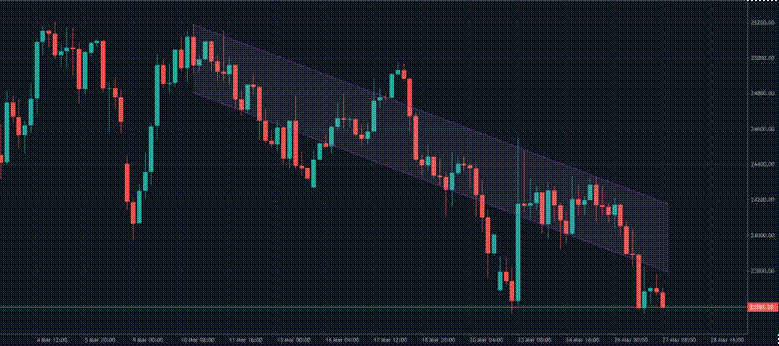
US futures are essentially flat: the Dow up 0.02%, the Nasdaq 100 down 0.01%, and the S&P 500 up 0.02%. The near-zero moves reflect a market that has absorbed a week’s worth of signal-and-reversal cycles, broken support levels across major indices, and duelling peace plans, and arrived at the week’s close in a state of exhausted equilibrium. Neither the bears nor the bulls have sufficient conviction in the current environment to make a meaningful directional commitment.
The Nasdaq’s clear regression over the past week is visible in the chart. Market participants have listened to the comments, processed the signals, and made their calls. The call they have made is captured in the observation that it is Trump’s bluster, not hard facts, keeping markets up. That assessment is both fair and analytically important. A market supported by presidential language rather than fundamental progress is as durable as the language is credible. As the extended deadlines and duelling peace plans erode the credibility of the US position’s optimistic framing, the bluster-based support becomes progressively less reliable.
The Nasdaq, having broken below 24,000 on Thursday and now trading around 23,588, is 412 points above the 23,000 level identified as the next major support. The distance is not large in the context of the week’s moves. Whether the 23,000 level is tested depends on what the weekend delivers in terms of conflict developments, which has been the pattern of significant geopolitical events arriving during non-market hours throughout this entire period.
European Equities: A Consistent Slide That Words Cannot Arrest
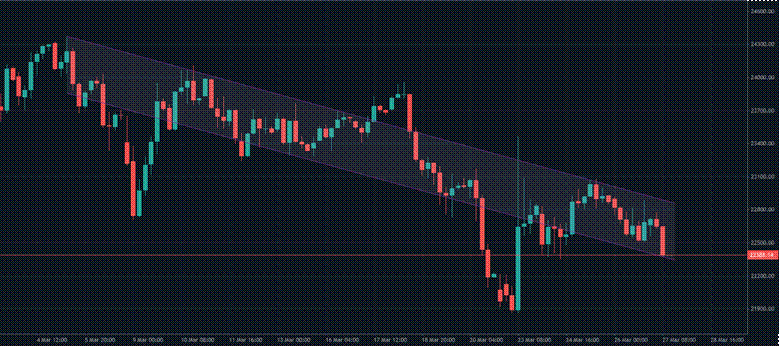
Germany 40 is down 0.90%, and the UK 100 is lower by 0.34%, both indices continuing the downward trajectory that has defined the week’s European session. The DAX’s characterisation as showing a consistent slide down, with words and bluster providing volatility but not the substance that markets need to sustain a recovery, is the week’s most honest market assessment.
The observation that markets need substance, and that substance is lacking, captures the essential structural problem of the current environment. Diplomatic signals that are immediately contested, peace plans that resemble surrender documents, deadlines that are extended rather than enforced, and a conflict whose architects appear to have no exit plan all constitute the absence of substance. The volatility those signals produce is real, visible in the week’s sharp moves in both directions. But volatility that lacks a directional underpinning from genuine progress does not translate into sustained recovery.
Germany’s slide continues against the backdrop of its specific vulnerabilities, noted throughout the conflict period. The broken long-term range identified on Thursday, with no clear support until 21,500, provides the technical framework for a Friday that is not recovering meaningfully despite near-flat US futures. The DAX’s downward trajectory, absent a genuine diplomatic breakthrough, is the path of least resistance given the structural headwinds that remain.
EURUSD in Limbo: The Currency Market’s Honest Position
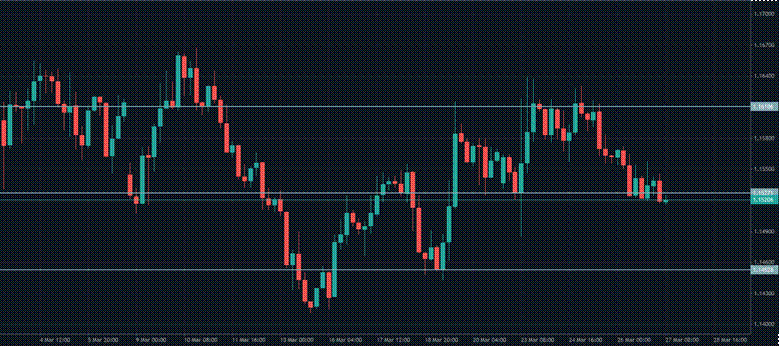
EURUSD is characterised as remaining in limbo, down a marginal 0.05%, and the description is accurate. A currency pair that has watched multiple rounds of diplomatic signals, peace plan reports, counterproposals, and deadline extensions without finding a directional catalyst is in genuine uncertainty about which scenario it is pricing. The safe-haven dollar bid remains but has not intensified. The euro’s recovery potential exists but lacks the confirmed diplomatic progress that would allow it to express itself.
GBPUSD is fractionally lower at-0.11%, and USDJPY is essentially unchanged at +0.01 %. The FX market’s near-stillness on Friday morning is the currency equivalent of the equity market’s exhausted equilibrium. Participants who have watched the conflict produce consistent signal-and-reversal cycles are not willing to commit to a direction until the primary variable, the conflict’s trajectory, provides something more reliable than duelling peace plans and extended deadlines.
The observation that the currency market is reactive rather than proactive, first made earlier in the conflict period and repeated throughout, remains accurate and will remain so until the conflict’s resolution, or at a minimum, a credible path toward it, provides the forward visibility that sustainable positioning requires.
The Week That Was: A Summary Assessment
The week opened with Monday’s support break and Israel’s several-week signal. It produced Wednesday’s peace plan rally as the most convincing positive session of the conflict period. Thursday reversed those gains on mixed messaging, with the Nasdaq breaking below 24,000 and the DAX exiting its long-term range. Friday delivers duelling peace plans, an extended deadline, and the honest assessment that neither side has an exit.
The net effect of the week is an extension of the conflict’s downward market trajectory at a slower pace than last week, but without any genuine progress toward resolution. The late-2025 gains remain erased. The support levels remain broken. The diplomatic process has produced more specificity than before, in the form of two competing plans with incompatible terms. Still, the specificity reveals the distance between the parties rather than the closeness of a settlement.
No major earnings are scheduled today. The session belongs to the conflict’s latest chapter and to a market that, by Friday of the fifth week of the conflict, is running on a depleted combination of bluster, scepticism, and exhausted equilibrium.
The Bottom Line
Friday opens with a market that has arrived at an honest reckoning with the conflict’s state. The 15-point peace plan was not a breakthrough; it was a maximalist opening position. Iran’s 5-point counter is not a negotiating concession; it is an alternative maximalist position. The gap between them is the gap between a demand for capitulation and a rejection of it. Another deadline has been extended. Neither side has an exit plan.
Markets are near-flat, held up by bluster rather than facts, making lower lows and lower highs on anything beyond the very short-term timeframe. Energy prices will probably remain elevated. The central bank’s tightening bias will remain in place. The geopolitical premium will persist. From the sidelines, the honest assessment is that this conflict is in for the long haul, and the market’s current level imperfectly but directionally accurately reflects the economic and financial cost of that reality.
Lunaro Financial Services Limited (trading as ‘Lunaro’) is an execution-only service provider. This material is a marketing communication and is provided for general information and educational purposes only. It does not take into account your personal circumstances, objectives or needs. Any opinions are those of the author at the time of writing and may change without notice. Nothing in this material constitutes (or should be construed as) financial, investment, legal, regulatory or tax advice, or a recommendation to engage in any investment activity. You should not rely on this material when making investment or trading decisions.
This material has not been prepared in accordance with legal requirements designed to promote the independence of investment research and is not subject to any prohibition on dealing ahead of the dissemination of investment research. Lunaro may deal as principal and/or have an interest in the financial instruments or markets referred to in this material in the ordinary course of its business, including at or around the time of publication, and does not seek to take advantage of this material prior to its dissemination.
While reasonable care has been taken in preparing this material, no representation or warranty is made as to its accuracy or completeness and Lunaro accepts no liability for any loss arising from any use of, or reliance on, this material.
Approximately 80% of retail investor accounts lose money when trading CFDs with this provider. You should consider whether you can afford to take the high risk of losing your money


Comments
Post a Comment